

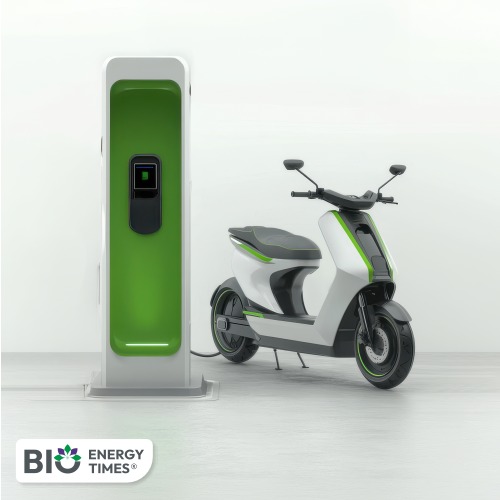
India continued to strengthen its role in the clean mobility and bioenergy transition in 2025, retaining its position as the world’s second-largest electric two-wheeler market and the leading electric three-wheeler market, despite slower growth caused by reduced subsidies and stricter localisation requirements, according to the International Energy Agency’s latest Global EV Outlook report, according to The Economic Times.
Global electric two-wheeler sales grew 15 per cent year-on-year to nearly 10 million units in 2025, accounting for around 14 per cent of worldwide two-wheeler sales. China maintained its dominance with sales exceeding 7 million units, while electric vehicles accounted for more than 55 per cent of the country’s two-wheeler market. Chinese sales increased by 10 per cent during the year.

India remained the second-largest electric two-wheeler market globally, with sales reaching approximately 1.3 million units in 2025. Electric models accounted for around 6 per cent of total domestic two-wheeler sales, although growth was considerably slower than in previous years.
According to the report, the moderation in growth was largely driven by changes in government incentive programmes. Under the earlier FAME-II scheme, electric two-wheelers were eligible for subsidies of up to $170 per kWh, covering as much as 40 per cent of vehicle costs. Under the PM E-DRIVE programme, incentives were reduced to $57 per kWh and capped at $115 per vehicle in FY25 before being lowered further in FY26 to less than $30 per kWh and a maximum of $57 per vehicle.
The report also noted that the introduction of stricter local content requirements increased compliance costs for manufacturers, resulting in fewer models qualifying for subsidies. At the same time, lower GST rates on internal combustion engine two-wheelers reduced the price advantage of electric vehicles.
Despite these challenges, India consolidated its leadership in the electric three-wheeler segment. More than two-thirds of all three-wheelers sold in the country during 2025 were electric, making India the largest market globally for the category.
Worldwide three-wheeler sales declined 16 per cent to around 4.5 million units in 2025. However, electric three-wheeler sales rose to more than 1.2 million units, increasing their share of the global market to over 25 per cent. China, India and Türkiye together accounted for more than 95 per cent of global electric three-wheeler sales.
India also retained its position as the world’s third-largest electric bus market for the second consecutive year. Sales crossed 4,000 units for the first time in 2025, supported by large-scale public procurement initiatives, including the PM E-DRIVE scheme.
The report highlights India’s growing contribution to the broader clean energy and bioenergy transition, with expanding electric mobility adoption continuing to play a key role in reducing dependence on conventional fossil fuels and supporting low-carbon transportation.













