

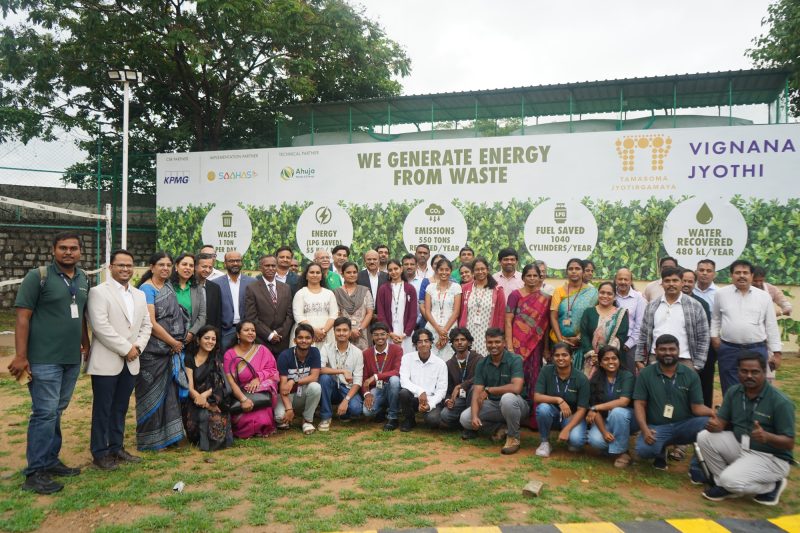
Hyderabad: In a signification step towards environmental sustainability, on World Ozone Day 2026, VNR Vignana Jyothi Institute of Engineering & Technology (VNRVJIET) has inaugurated a 1 metric tonne per day (TPD) biogas plant at the Vignana Jyothi hostel complex, converting food waste generated on campus into renewable energy for cooking and nutrient-rich organic manure for plantation. The project was formalised through an MoU inked between VNR VJIET and KPMG, paving the way for the development of the biogas plant. The joint initiative represents a total investment of INR 60 lakhs, bringing together CSR support and partner contributions to establish the 1 TPD biogas facility and its associated infrastructure.
With a processing capacity of up to 1,000 kg of organic waste per day, the plant will address the approximately 800 kg of food waste generated daily across the hostel kitchens and canteens. The biogas generated is now being utilised through dedicated burners in the Vignana Jyothi Hostels, where the canteens are fully functional on renewable energy for their cooking requirements. The organic manure generated as a by-product will be used for plantation and green-cover development across the campus, creating a closed-loop approach to resource utilisation.

At full utilisation, the plant is expected to generate approximately 48 kg of biogas per day, equivalent to around 2.5 commercial LPG cylinders, or approximately 750 commercial LPG cylinders annually. This is estimated to represent an annual energy value of INR 22 lakhs, while reducing the institution’s dependence on LPG as a conventional cooking fuel. The initiative is also projected to deliver significant environmental gains, including 550 tonnes of CO₂ emissions avoided annually, savings of around 1,040 LPG cylinders per year, and recovery of approximately 480 KL of water annually.
The project is also expected to deliver a significant environmental impact by processing approximately 180 metric tonnes of food waste annually, thereby diverting wet waste from landfills and reducing the associated greenhouse gas emissions. At 100% utilisation, the plant is projected to mitigate approximately 600 tonnes of CO₂ emissions annually. By replacing a portion of conventional LPG consumption with renewable biogas, the initiative further contributes to energy conservation, reduction in fossil-fuel dependence and India’s broader sustainability goals.
Speaking on the inauguration, Mr. Durga Prasad Kode, IPS (Retd.), General Secretary, Vignana Jyothi said, “With the biogas plant, we are taking a step towards creating campuses where resources are recovered, energy is generated locally, and sustainability becomes part of the institution’s operating ecosystem. Our ambition is to take this thinking beyond a single campus and demonstrate how educational institutions can evolve into self-sustaining ecosystems for resource recovery. Building on the success of this initiative, we are exploring its replication at the Dr. Rama Naidu Vignana Jyothi Institute of Rural Development, taking us closer to our larger vision of creating institutions that give back more to the environment than they consume.”
The joint initiative was funded by KPMG under its CSR initiatives with a significant contribution from Vignana Jyothi through Saahas, an NGO working to enable India’s transition towards a circular economy. Ahuja Waste & Energy served as the technical partner responsible for the design, installation and commissioning of the plant.
Beyond its immediate operational impact, Vignana Jyothi intends to use the facility as a Centre of Excellence in Sustainable Waste Management, providing engineering students with hands-on exposure to renewable energy, waste-to-energy systems, environmental engineering and circular-economy practices. The facility will also offer a practical learning platform for school students associated with Vignana Jyothi Society and other institutions across Hyderabad.
Spokesperson from KPMG said, “Supporting this initiative is aligned with our commitment to enabling solutions that create measurable environmental and social impact. The project demonstrates how a campus can transform an everyday waste challenge into a source of renewable energy, while reducing emissions and dependence on conventional fuels. We are pleased to partner with Vignana Jyothi on an initiative that has the potential to become a replicable model for sustainable waste management in educational institutions.”
The initiative forms part of Vignana Jyothi’s broader commitment to environmental sustainability, which includes investments in solar energy, sewage treatment, rainwater harvesting, green-cover development and responsible waste management. The long-term vision is to move towards a Zero-Waste and Carbon-Neutral Institution, with the next phase focusing on strengthening systems for the collection, segregation, treatment and recycling of plastic and other waste streams generated across the campus.













