

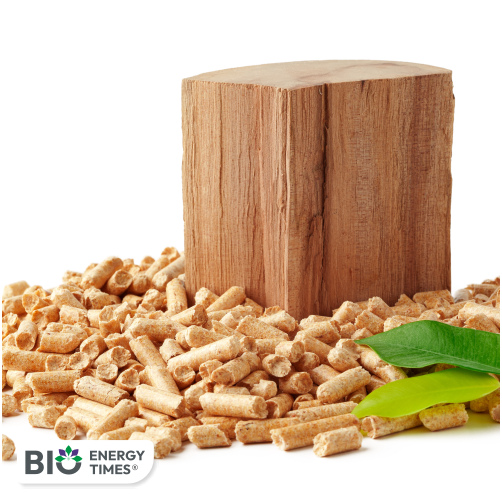
A research study has found that combining corncob residue with African birch wood can produce a hybrid solid biofuel with favourable thermal properties, offering a potential alternative to conventional wood-based fuels for domestic and industrial applications, Bioengineer.org reported.
Using statistical mixture design software Minitab 19, researchers identified an optimal corncob-to-African birch wood ratio of 3:22. The blend recorded a higher heating value of 16.82 megajoules per kg and an ash content of 2%, indicating its potential for process heating applications.

The study examined the use of agricultural residues as a partial substitute for woody biomass to reduce dependence on conventional wood resources. Although woody biomass has relatively high energy content, its excessive utilisation raises concerns over resource depletion and environmental sustainability.
Researchers collected, sorted and pulverised corncob and African birch wood samples before evaluating their heating values and ash content.
The analysis showed that raw corncob had a heating value of 14.21 megajoules per kg and an ash content of 3.46%. African birch wood recorded a higher heating value of 17.80 megajoules per kg, with an ash content of 1.52%.
The researchers used Minitab 19 to determine the most suitable combination of the two feedstocks. The resulting 3:22 blend achieved a heating value of 16.82 megajoules per kg and an ash content of 2%.
Thermal performance and combustion analysis
The thermal degradation behaviour of the optimised biomass blend was examined through thermogravimetric analysis. Researchers also evaluated its thermal decomposition kinetics using four mathematical models: Tang, Starink, Kissinger–Akahira–Sunose (KAS) and Ozawa–Flynn–Wall (OFW).
The estimated activation energy varied across the models. The Tang model recorded 194.22 kilojoules per mole, while the Starink model estimated 197.12 kilojoules per mole. The KAS and OFW models reported activation energies of 208.09 and 226.17 kilojoules per mole, respectively.
The study concluded that the optimised corncob and African birch wood blend has suitable thermal characteristics for solid biofuel applications.
The findings highlight the potential of combining agricultural residues with woody biomass to develop alternative fuels for domestic and industrial process heating. Such utilisation could improve the value of agricultural waste, reduce dependence on raw wood and contribute to the development of more sustainable biomass energy systems.