
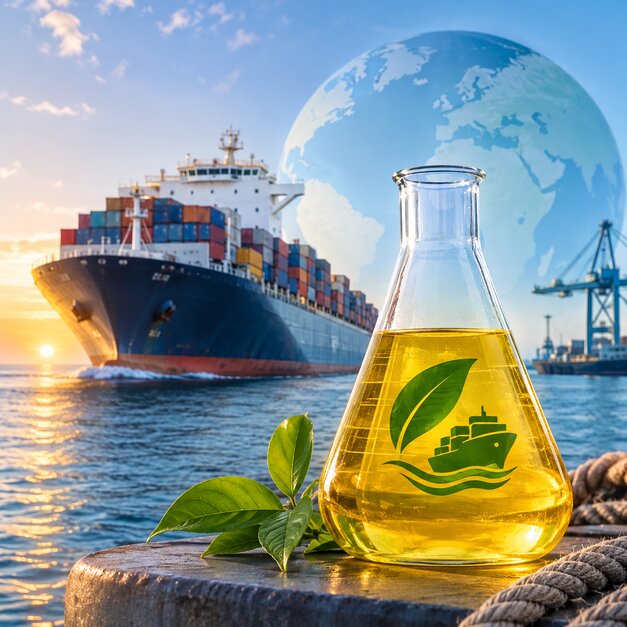
Demand of marine biodiesel could increase significantly by 2031, driven by stricter emission regulations and the shipping industry’s transition towards lower-carbon fuels, according to the International Energy Agency (IEA), Safety4sea reported.
In its Renewables 2026 report, the IEA projected that marine biodiesel consumption could rise from just under 1 billion litres annually in 2025 to nearly 2 billion litres by 2031 under its main scenario, which does not include the implementation of the International Maritime Organization’s (IMO) proposed Net-Zero Framework.

However, demand could exceed 12 billion litres annually by 2031 under an accelerated scenario that factors in the implementation of the IMO framework and other announced policy measures.
The difference between the two projections highlights the potential impact of international emission regulations on marine biofuel demand, investment in production facilities and fuel supply infrastructure.
FuelEU Maritime to drive near-term demand
The IEA identified the European Union’s FuelEU Maritime regulation as the primary driver of marine biodiesel demand under its main scenario.
The regulation requires ships covered by its provisions to progressively reduce the greenhouse gas intensity of the energy they consume, measured on a well-to-wake basis. This is expected to encourage shipping companies to adopt fuels with lower lifecycle emissions.
Europe is projected to account for around 80% of the growth in marine biodiesel demand through 2031. Demand is also expected to increase in the Asia-Pacific region, particularly at major bunkering hubs supplying vessels operating on routes to European ports.
The projections indicate that biodiesel could play an important role in reducing emissions from the shipping sector in the near term, while infrastructure and production capacity for other alternative marine fuels continue to develop.
IMO framework could accelerate marine biofuel adoption
The proposed IMO Net-Zero Framework is expected to have a significant influence on the future demand for renewable marine fuels.
The framework aims to establish global requirements for reducing the greenhouse gas intensity of energy used in international shipping. Its adoption vote, initially expected in 2025, was postponed to December 2026.
If implemented, the framework could expand the use of lower-emission fuels beyond vessels operating under regional regulations, creating additional demand across international shipping routes.
Under the IEA’s accelerated scenario, the Asia-Pacific region could account for a substantial share of the additional marine biodiesel demand, reflecting its importance as a global shipping and bunkering centre.
However, the projection of more than 12 billion litres by 2031 is conditional on the implementation of the proposed framework and other policy measures. It is not the agency’s baseline forecast.
Sustainability standards critical for biofuel growth
The IEA has also highlighted the importance of sustainability standards in determining the environmental benefits of marine biodiesel and other liquid biofuels.
The actual reduction in greenhouse gas emissions depends on several factors, including the feedstock used, production processes and supply chains.
According to the agency, performance-based standards and greenhouse gas emission thresholds already cover approximately 80% of global liquid biofuel demand.
However, stronger sustainability frameworks are required to verify actual emission reductions and address concerns related to land use, water resources and biodiversity.
The projections underline the growing role of policy support in creating demand for renewable marine fuels. For the biofuel industry, the expansion of marine biodiesel markets could create additional opportunities for feedstock suppliers, producers and fuel distributors, provided that sustainability requirements and international emission standards are met.