
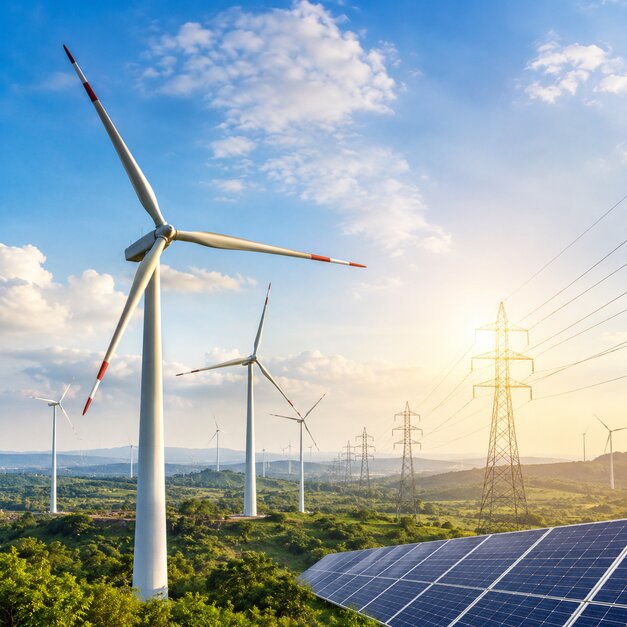
NEW DELHI: India’s renewable energy capacity has crossed 290 GW, while the country achieved 50 percent of its installed electricity capacity from non-fossil sources in 2025, five years ahead of its 2030 target. However, experts at the 8th International Conference on Sustainability Education (ICSE) 2026 emphasised that translating these gains into sustained climate action will require stronger implementation, green skills and a workforce equipped for the emerging clean-energy economy, according to a press release.
Speaking at the inaugural session of ICSE 2026, Pradip Burman, Chairman, Mobius Foundation, highlighted India’s progress on its clean-energy commitments while underscoring the need to bridge the gap between ambition and implementation.

“In 2025, India achieved 50 percent of its installed electricity capacity from non-fossil sources, five years ahead of the 2030 target. Our renewable energy capacity has now crossed 290 gigawatts. This is significant progress, but the journey is far from over,” said Burman.
The discussions at ICSE 2026 highlighted that India’s energy transition will require capabilities extending beyond renewable energy deployment. Green jobs, critical minerals, e-waste and battery recycling, sustainable technologies and innovation emerged as important areas for building the skills and systems needed to support a low-carbon economy.
Priyanka Sharma, President and CEO, Mobius Foundation, said sustainability has evolved from being primarily an environmental conversation to one that encompasses economic growth, livelihoods, work and well-being.
“Sustainability is no longer simply an environmental conversation. It is a conversation about how we live, how we learn, how we work, how we create prosperity and ultimately how we create well-being and wellness for people and the planet,” she said.
The need to prepare young people for the emerging green economy was also emphasised during the conference. As India expands its clean-energy ecosystem, sustainability education and practical green skills will play an increasingly important role in preparing the workforce for opportunities across renewable energy, resource efficiency, circular economy and clean technologies.
Dr. Vibha Dhawan, Director General, The Energy and Resources Institute (TERI), highlighted the need to rethink existing systems and infrastructure through a sustainability lens. She pointed to school transportation as one example where infrastructure and policy choices can influence emissions and contribute to more sustainable mobility systems.
The conference also examined the role and limitations of technology in addressing the climate crisis. Prof. Bhaskar Vira, Pro-Vice-Chancellor for Education and Environmental Sustainability, University of Cambridge, cautioned against relying on technology alone to solve environmental challenges and emphasised the importance of enabling citizens to actively participate in the transformations required for a sustainable future.
The discussions come at a time when India’s energy transition is creating new requirements across the clean-energy value chain, from renewable energy and sustainable mobility to critical minerals, battery recycling and green jobs. ICSE 2026 is bringing together policymakers, educators, scientists, industry leaders and young people to examine how education can support this transition and convert sustainability commitments into meaningful action.
The two-day conference features sessions on climate action, green skills, technology and innovation, biodiversity and sustainable livelihoods, alongside dedicated youth programming bringing students and young climate leaders into the sustainability conversation.