
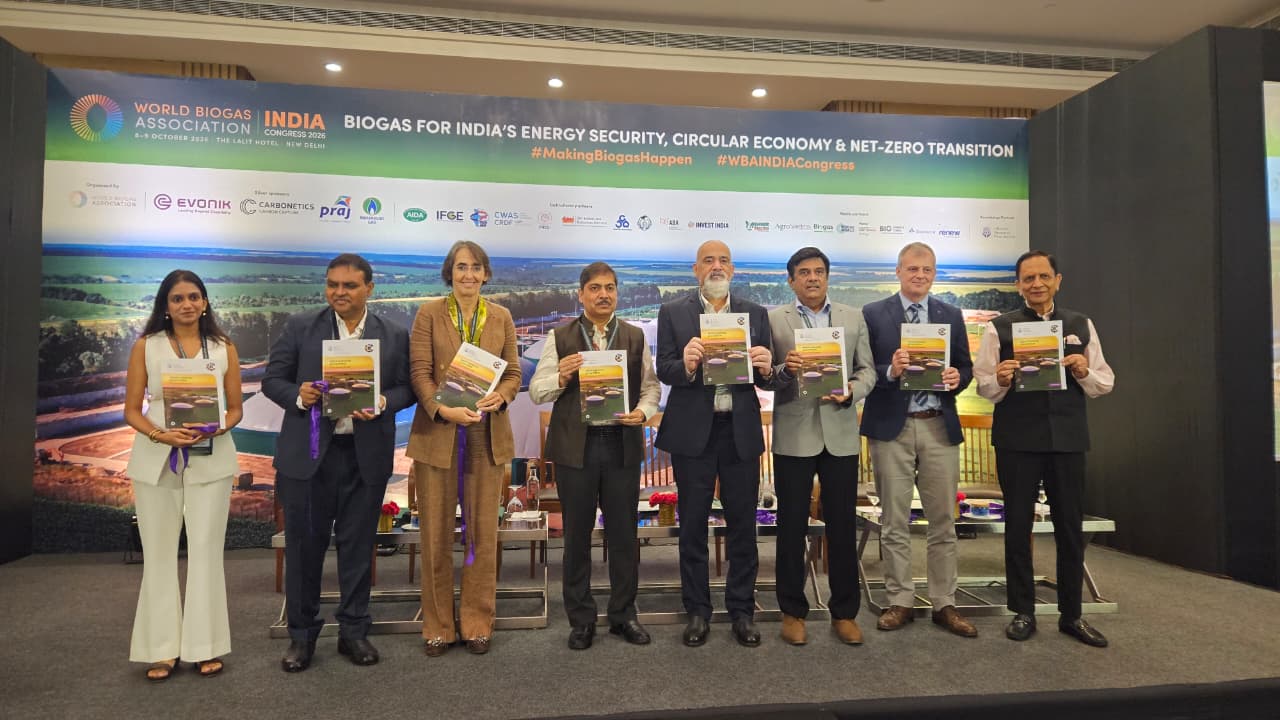
The success of compressed biogas (CBG) projects in India will depend heavily on feedstock management, technology selection and effective utilisation of by-products, said Atul Mulay, President Praj Industries at WBA India Congress 2026, highlighting key differences between CBG and established liquid biofuel projects.
Speaking at an industry event, Mulay said feedstock was the most important factor for CBG and other biotechnology-based projects. Unlike conventional liquid biofuels, CBG projects typically begin with waste, creating challenges around its collection, aggregation and conditioning before it enters the main processing system.

The quality of feedstock can also vary significantly depending on the region and season, making its mechanical and microbiological conditioning critical to the performance of a CBG plant, he said.
Mulay said this was an important distinction between liquid and gaseous biofuels. Technologies for liquid biofuels have been established globally over several decades, with performance and efficiencies relatively well understood. CBG projects, however, face greater uncertainty because the performance of the main reactor is closely linked to the quality and consistency of the feedstock entering it, he added.
Praj had fingerprinted more than 8,000 feedstock samples globally, giving it a database of different feedstock characteristics, he said, adding that in India, however, feedstock characteristics can vary considerably from one region to another and across different seasons.
This makes the assessment and selection of appropriate technology particularly important for project developers, he said.
Mulay also pointed to the longer time required to assess the performance of CBG technology compared with liquid biofuel projects. While the performance of a liquid biofuel process can be assessed relatively quickly, CBG processes require much longer periods because of the biological nature of the process.
For project developers, this creates an additional risk because a technology may take a considerable period to demonstrate its actual capacity, efficiency and quality, he said. By the time shortcomings become evident, the project may already have progressed significantly, making technology selection a critical factor in project viability, he added.
Another major challenge is the management and utilisation of the liquid and solid by-products generated during CBG production.
Mulay said disposal and utilisation of organic digestate remained a challenge for the industry. While the material can potentially be used in agriculture, its performance and impact on crops need to be assessed carefully rather than assuming that it can immediately be applied to farmland.
He said agricultural application requires coordination with farmers, agricultural institutions and research organisations. The impact of organic inputs on crops may take several years to become fully evident, making long-term field trials important.
Praj, he said, has been conducting trials involving liquid and solid organic by-products on wheat for the past two years in collaboration with a sugar research institution. While some results have been encouraging, others have highlighted the challenges associated with variations in feedstock and crop response.
Mulay urged greater collaboration among technology providers, project developers, industry associations, farmers and research institutions as India’s CBG sector expands.
He also drew a comparison with the development of India’s liquid biofuel industry, saying the experience and learnings from established biofuel programmes could provide useful lessons for the emerging CBG sector.
The government has created a significant opportunity for the circular economy through its CBG push, he said, but the industry’s long-term success will depend on project developers selecting appropriate technologies and building partnerships with the right stakeholders, he said.
Mulay emphasised that proper feedstock assessment, technology selection and management of CBG by-products would be central to ensuring that projects deliver sustainable outcomes for both developers and the farming community.