
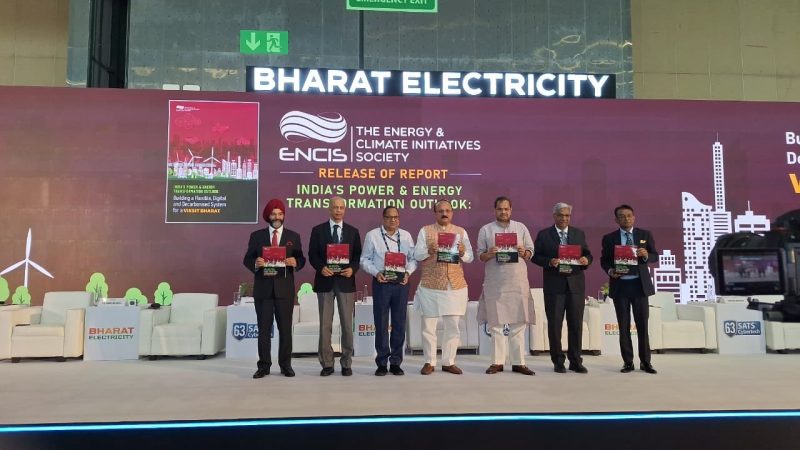
New Delhi: India’s installed electricity capacity is projected to soar beyond 2,000 GW by 2047, nearly four times today’s levels, driven by a dramatic expansion in clean energy, says ENCIS outlook report. The report, titled “India’s Power & Energy Transformation Outlook,” was released today at Yashobhoomi, New Delhi, during the inaugural session of Bharat Electricity, POWERGEN India & Indian Utility Week 2026. It further reveals that solar power alone is expected to leap from 119 GW to over 1,100 GW, underscoring the scale of infrastructure, innovation, and policy support required for the nation’s Viksit Bharat vision.
The inaugural session brought together a distinguished line-up of sector leaders and government dignitaries. Bhupinder Singh Bhalla, IAS (Retd.), Honorary Chairperson of the Governing Council for Bharat Electricity, POWERGEN India and Indian Utility Week 2026 and Former Secretary, Ministry of New and Renewable Energy, Government of India; P.K. Pujari, IAS (Retd.), Honorary Chairperson of ENCIS; Dr. D Sai Baba, Additional Secretary, Ministry of Power, Government of India; Ghanshyam Prasad, Chairperson, Central Electricity Authority (CEA); Shailesh Kumar, Hon’ble Minister of Energy, Government of Bihar; Ashish Sood, Hon’ble Minister of Home, Power, Urban Development and Education, Government of NCT of Delhi and Abhishek Bhatnagar, Director General, ENCIS, were among the dignitaries present.
Bhupinder Singh Bhalla, IAS (Retd.), Honorary Chairperson of the Governing Council for Bharat Electricity, POWERGEN India and Indian Utility Week 2026 and Former Secretary, Ministry of New and Renewable Energy, Government of India, said, “India’s energy transition is now about orchestration, not just expansion. Our next phase will be judged not by the number of gigawatts added, but by whether we build a system that is reliable every hour, affordable for every consumer, flexible under stress, and secure against disruption.”
The report details how non-fossil sources have already reached 53% of India’s 540 GW installed capacity, five years ahead of target, while peak electricity demand has nearly tripled since 2000 and is forecast to reach 366 GW by 2032, a 34% jump, driven by new loads from data centres, e-mobility, and green hydrogen.
Ghanshyam Prasad, Chairperson, Central Electricity Authority (CEA), said, “India is experiencing phenomenal growth in the power sector, with record annual capacity additions and a rapid shift toward clean energy. But it’s not just about adding megawatts; our real challenge now is to build a grid and market architecture that can integrate renewables, storage, and new technologies at scale, ensuring reliability, flexibility, and affordability for a future-ready economy.”
The report further highlights that India must nearly triple its renewable energy deployment by 2030, reaching 500 GW of non-fossil capacity while maintaining system reliability. Grid-scale storage will need a forty-fold increase to 200 GWh by 2030, marking the most significant infrastructure leap in the sector’s history.
Ashish Sood, Minister of Home, Power, Urban Development and Education, Government of NCT of Delhi, said, “Delhi’s experience shows that better management, technology, and investment can fundamentally transform the performance of an urban power system. Our grid must always stay ahead of the city’s demand.”
The report also notes that nationwide smart meter deployment is on track to reach 250 million units by FY2028, enabling real-time management of 90% of consumer demand and pushing average AT&C losses below 10% nationally for the first time. Although digital reforms have already reduced AT&C losses to 15%, the distribution segment remains a critical bottleneck, with 44 GW of renewables stuck in contract or financing limbo.
Shailesh Kumar, Minister of Energy, Government of Bihar, said, “As India’s energy landscape evolves, Bihar is ready to partner with industry and international investors, offering land, infrastructure, and policy support to help shape the next chapter of India’s clean energy growth.”
Coal will continue to provide grid stability, with plants needing to operate at 40% minimum technical load and 3% ramp rates by 2030. Overall, India’s power sector investment requirement is pegged at $0.5 trillion by 2030, and more than one million new skilled workers will be needed to deliver the digital and clean energy transformation.
Organised by The Energy & Climate Initiatives Society (ENCIS), the three-day event convenes more than 15,000 professionals, over 250 exhibitors, and 150 global thought leaders from 40 countries. Major sponsors and participating organisations include Adani, NTPC, Coal India, NLC, Tata Power, ReNew, EDF, Schneider Electric, Toshiba, JSW, Kirloskar Brothers, and others.
Delegations from the US, UK, Germany, France, Japan, South Korea, Australia, UAE, Singapore and more have gathered in New Delhi to advance India’s clean energy and technology ambitions.
Guided by the theme “Shaping Energy Sovereignty • Building Climate Resilience • Powering Viksit Bharat,” Bharat Electricity, POWERGEN India & Indian Utility Week 2026 is more than a showcase; it is a catalyst for next-generation energy solutions, manufacturing, and global collaboration.