
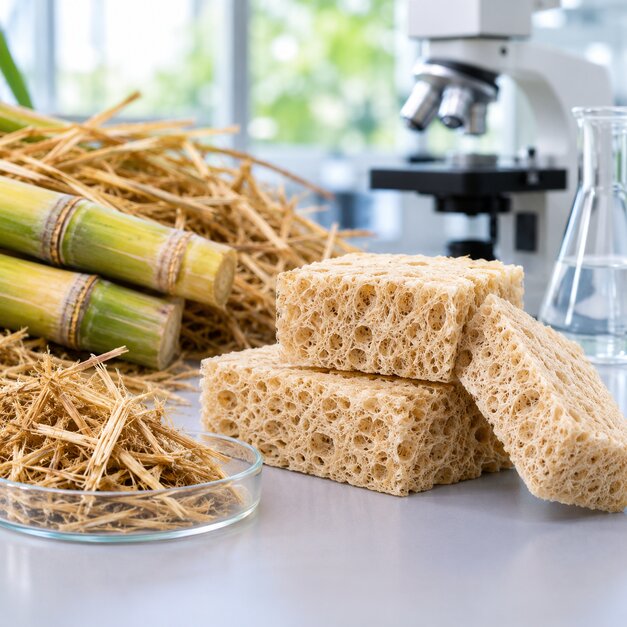
Researchers have developed highly porous, bio-based materials using sugarcane bagasse and straw, opening up new possibilities for converting sugarcane processing waste into higher-value products. The study used methods similar to those followed in industrial paper production to extract lignin from the residues and convert it into cryogels and xerogels, which are lightweight materials with a porous structure, Bioengineer.org reported.
The materials contained more than 70% renewable content, while the porosity of the cryogels reached up to 73.04%. The researchers also found that adding a small quantity of nickel sulphate helped speed up the formation of the material’s structure. In some formulations made from lignosulfonate, this reduced the preparation time from 24 hours to six hours.

The study highlights the potential to use agricultural residues as alternatives to materials derived from petroleum in the manufacture of specialised products. It also points to new ways of using sugarcane bagasse and field residues as raw materials in a circular bio-based industry.
Sugarcane cultivation generates large quantities of plant waste across the world. Global sugarcane production is estimated to offer an annual potential of around 495 million tonnes of dry plant material.
Bagasse, the fibrous material left after sugarcane is crushed, is commonly used as fuel in sugar mills or as a raw material for paper production. Sugarcane straw, also known as field trash, is generally left in agricultural fields after harvesting to protect the soil and return minerals to it.
However, both residues contain significant amounts of lignin, a natural component of plant material. Lignin accounts for around 19% to 32% of sugarcane bagasse and 17% to 41% of sugarcane straw. Despite its potential for making advanced materials, more than 60% of industrial lignin recovered commercially is still burnt as a low-grade fuel.
The researchers noted that using lignin to develop new materials has been difficult because of its complex chemical structure, varying composition and high mineral content.
For the study, the team collected unwashed sugarcane bagasse and straw from Usina Ipiranga Agroindustrial in Descalvado, São Paulo, Brazil. They used laboratory equipment to carry out a process similar to kraft pulping, in which the plant material is treated with sodium hydroxide and sodium sulphide under high temperature and pressure to separate lignin.
The researchers then recovered lignin from the resulting liquid by adding sulphuric acid. This method increased the recovery of lignin from bagasse by up to 2.7 times and from straw by up to 2 times compared with a method using carbon dioxide to separate it.
Chemical analysis showed that the lignin extracted from sugarcane straw contained 82.84% lignin and 10.02% carbohydrates. The bagasse-derived lignin contained 70.05% lignin and 24.68% residual carbohydrates. The straw lignin also had a higher mineral content, mainly due to silica.
The findings suggest that both sugarcane bagasse and straw could serve as useful raw materials for producing renewable porous materials, adding value to agricultural residues that are commonly used as fuel or left in fields.