
India’s Compressed Biogas (CBG) sector has entered a new phase. It has moved from the SATAT initiative, launched in October 2018 to create a market for renewable gas, to a full GOBARdhan policy framework covering demand, pricing, investment, infrastructure and financing.
The main question for developers was no longer only whether there was an opportunity to set up a CBG plant. The question, now, is how to build a project that can run sustainably and commercially at scale.

The big picture: creating a CBG market to building an integrated ecosystem
India’s efforts to build a viable CBG industry have progressed significantly over the past eight years. It said growing emphasis on energy security, indigenous fuel production, waste management and the circular economy had brought CBG into sharper focus as an important part of the country’s clean energy transition.
The journey gained momentum in October 2018 with the launch of Sustainable Alternative Towards Affordable Transportation (SATAT). Under the initiative, entrepreneurs were invited to set up CBG plants, and Oil Marketing Companies (OMCs) offered to buy the gas at an assured price. Praj said this gave an early demand signal and encouraged private participation in a sector that was then at a nascent stage.
However, that SATAT had its own limitations. It provided a market link for CBG but did not fully resolve offtake assurance, pricing, feedstock or implementation.
SATAT linked CBG prices to compressed natural gas (CNG) retail prices. That link did not adequately reflect wide variations in feedstock cost, logistics, plant scale and geography. As a result, the write-up said, many projects reported CBG output below rated capacity and lower internal rates of return, and the pricing mechanism worked only for certain feedstocks in specific locations.
The developers faced particular challenges from the dispersed nature of agricultural residues, limited collection infrastructure and the need for assured year-round supply. It added that these factors at times contributed to cautious investor sentiment and a relatively slower pace of project establishment under SATAT.
Limited pipeline connectivity made the offtake constraints worse. Producers had to rely more on the cascade route, which raised transport costs and operational complexity for the OMCs buying the gas. SATAT’s scope was not wide enough to create an organised biomass aggregation ecosystem.
In several cases, plants ran below capacity because feedstock supply was inconsistent or cost more than had been assumed at the investment stage. The lack of an effective single-window mechanism for government permissions caused delays and raised transaction costs, which hurt smaller developers in particular.
SATAT succeeded in validating demand. It had limited success, however, on remunerative and feedstock-sensitive pricing, assured offtake, integrated logistics, organised biomass supply chains and faster approvals.
The Indian government and policymakers recognised these limitations in good time and responded with Galvanizing Organic Bio-Agro Resources Dhan (GOBARdhan). The scheme promotes the conversion of cattle dung and other organic waste into biogas, bio-CNG and organic manure. Its focus went beyond fuel production and linked waste management with sanitation, rural livelihoods and resource recovery.
SATAT helped lay the foundation for India’s CBG ecosystem. However, several challenges became apparent as the sector grew, including feedstock aggregation, project financing, gas evacuation, pricing uncertainty, plant performance and the commercial use of organic manure. All of these continued to affect project viability, and the next phase of policy set out to address them together.
The Union Cabinet approved a new, integrated Central Sector Scheme under GOBARdhan on August 6, 2026, and the scheme was formally launched on October 1, 2026. It has a financial outlay of Rs 23,731 crore over 10 years and aims to raise domestic CBG production nearly tenfold, to about 5 million standard cubic metres per day (MMSCMD).
This an important shift in India’s CBG policy. The focus has moved from encouraging individual plants to building an integrated ecosystem that supports their development, financing, connectivity and long-term operation.
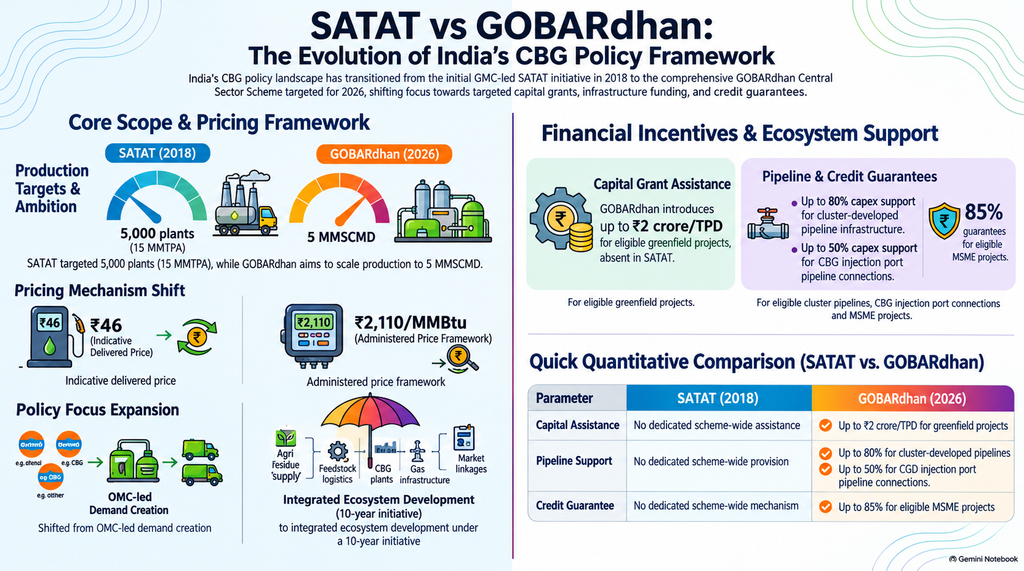
SATAT vs GOBARdhan: numbers tell the story
SATAT and GOBARdhan are complementary initiatives rather than competing ones. SATAT set up an early procurement-led route to market, and the original GOBARdhan initiative dealt with organic waste utilisation. The 2026 Central Sector Scheme brings a wider set of CBG-sector interventions under one framework.
The policy discussion is no longer only about setting up plants. It is increasingly about improving the conditions under which plants can reach financial closure, connect to markets and operate reliably over the long term.
The new scheme brings six interventions under one umbrella to address some of the biggest challenges in building and running a CBG project. The Ministry of Petroleum and Natural Gas (MoPNG) is the central nodal authority for the scheme. This arrangement has effectively resolved developers’ concerns under SATAT about having to deal with multiple authorities for permissions and financial incentives.
Pillar 1: assured offtake
The first pillar is assured offtake through a dedicated framework linked to the CBG Blending Obligation (CBO).
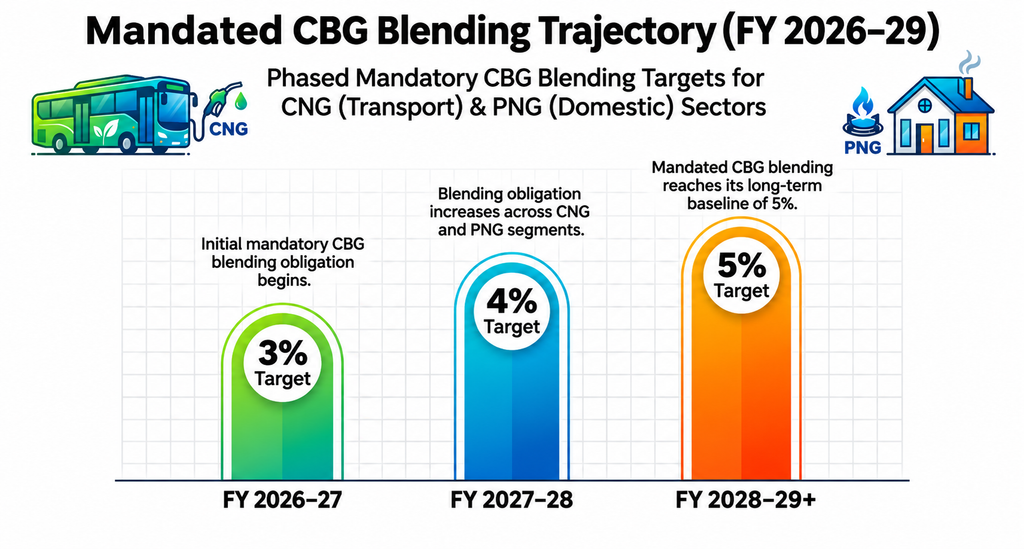
CBG plants will be mapped to identified City Gas Distribution (CGD) geographical areas (GAs) or to CBG clusters, giving them a dependable route to market. GAIL (India) Limited (GAIL) has been made the synchro operator for CBG offtake under the scheme.
The offtake framework gives developers a stronger demand signal and better visibility of market access. It added that developers can now identify the relevant CGD network, offtake arrangements, gas delivery requirements and connectivity while planning the project.
Pillar 2: stable CBG pricing framework
The second pillar is a stable pricing framework. The scheme sets an administered CBG price of Rs 2,110 per million British thermal units (MMBtu), equal to about Rs 100 per kg of CBG. The price is backed by the government for a minimum of 10 years and excludes taxes, as well as compression and transport charges for CBG moved through cascades.
This assured price is meant to give producers greater revenue visibility while a prescribed cost-sharing mechanism keeps the gas affordable for consumers. This means a more predictable pricing reference could strengthen financial modelling, investment evaluation and discussions with lenders. However, the actual project returns would still depend on feedstock costs, transport, operating efficiency, financing and delivery arrangements.
Pillar 3: capital assistance for CBG projects
Under the third pillar, eligible greenfield projects can receive capital assistance of up to Rs 2 crore per tonne per day (TPD) of installed CBG capacity, with a ceiling of Rs 30 crore per project. The assistance has two components. The first is Rs 1.25 crore per tonne of CBG capacity for plant and machinery. The second is Rs 0.75 crore per tonne for feedstock and manure production facilities.
Eligible brownfield projects that are expanding capacity can receive up to Rs 60 lakh per tonne of CBG capacity for machinery that upgrades raw biogas to CBG. The scheme explicitly excludes liquid feedstocks for CBG plants.
The second component goes beyond core plant machinery. It also covers feedstock aggregation infrastructure, processing facilities for fermented organic manure (FOM) and liquid fermented organic manure (LFOM), and equipment for organic manure value addition. This support recognises the wider infrastructure a CBG plant needs to be commercially viable, and it advised developers to check which parts of their investment are eligible before finalising their capital structure.
However, the capital assistance is released against milestones. Developers receive 25 per cent on obtaining consent to establish (CTE) and another 25 per cent after the first sale of CBG from the project. The remaining 50 per cent is paid after the plant shows continuous round-the-clock operation for three months. The Centre for High Technology (CHT) is the nodal agency that evaluates and audits the capital assistance proposals.
This milestone-based structure makes the choice of technology and engineering, procurement and construction (EPC) partner critical for every CBG investor. An integrated technology and EPC approach can help developers reduce execution risks, ensure reliable plant performance and achieve sustained operations with consistent CBG production. These factors are particularly important for meeting key assistance conditions and completing project milestones on time.
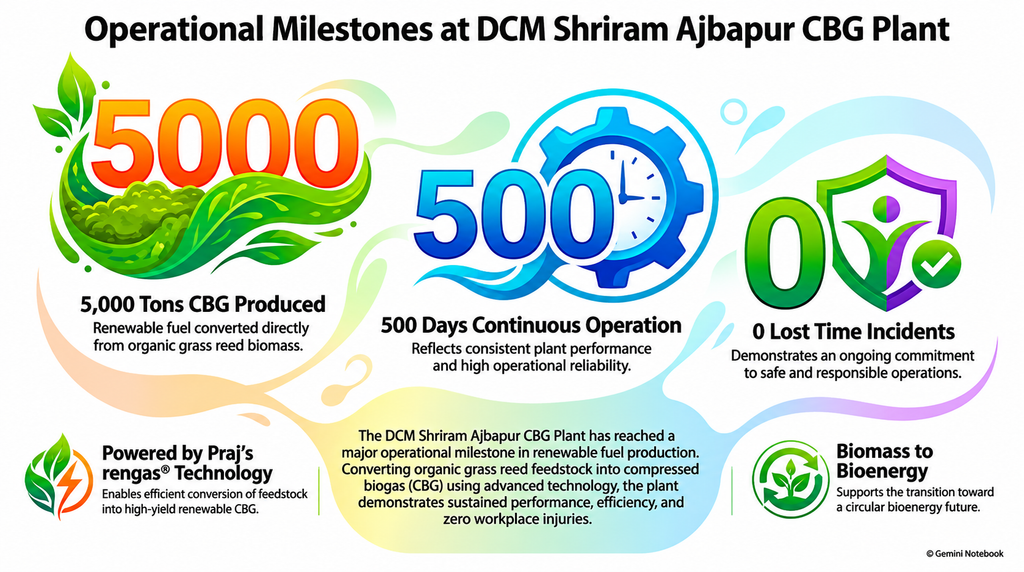
The DCM Shriram CBG plant, which operates on Rengas technology developed by Praj Industries, is one example of a project demonstrating the importance of technology and operational reliability.
Pillar 4: pipeline infrastructure development
The fourth pillar covers pipeline infrastructure. Gas evacuation is a critical consideration, particularly for plants located far from existing gas distribution networks. The scheme provides up to 80 per cent of eligible capital expenditure for cluster pipelines that connect to trunk pipeline networks, and up to 50 per cent for standalone plant connections to CGD networks.
Developers can now factor possible pipeline support into their choice of project location. Cluster-based development may also allow projects to share infrastructure costs and improve the economics of connectivity.
Pillar 5: credit guarantee support
The fifth pillar is a dedicated credit guarantee mechanism for eligible micro, small and medium enterprise (MSME) CBG projects. It can cover up to 85 per cent of the outstanding amount at default. The guarantee is capped at Rs 20 crore per project for general MSME projects and Rs 25 crore per project for women-led MSME projects.
The mechanism is designed to reduce lender risk and encourage institutional credit. However, the guarantee is neither a direct grant nor an automatic loan approval, and project and borrower eligibility conditions still apply.
Pillar 6: CBG ecosystem challenge fund
The sixth pillar is a CBG Ecosystem Challenge Fund. It recognises that a CBG plant depends on a wider network of resources and stakeholders, and it supports feedstock mapping and aggregation, district-level CBG development, technology advancement, process improvement, capacity building and organic manure value addition.
The focus is shifting from isolated plants to integrated local ecosystems consisting of collaboration with farmers, cooperatives, local bodies, aggregators and fertiliser stakeholders may become increasingly important.
The CBG opportunity in numbers: understanding the scale of ambition
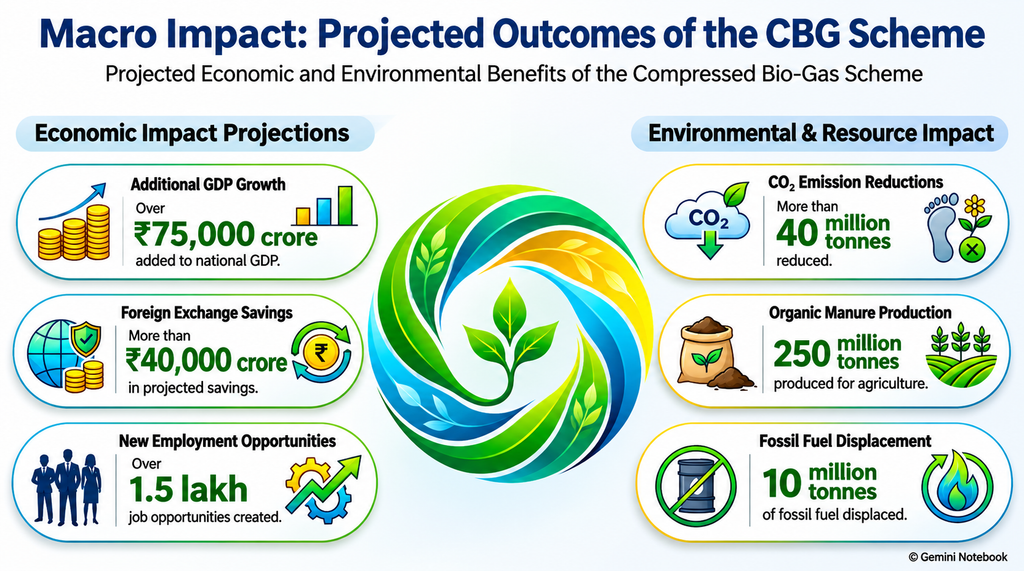
The government has projected substantial economic and environmental benefits over the scheme period. These are projected outcomes, but they underline the potential of CBG to contribute to energy security, rural economic development and the circular economy.
Policy alert: gas quality monitoring requirements
Alongside financial and infrastructure support, developers should also keep track of the scheme’s technical and compliance requirements.
On October 19, 2026, the MoPNG issued a clarification on the Online Gas Chromatograph (GC) requirement under the GOBARdhan CBG pricing framework.
Under a one-time transitional arrangement, eligible operational CBG plants with a functional Online Gas Analyser can be considered under the administered price framework until March 31, 2027, subject to other applicable conditions. From April 1, 2027, plants must install and commission the prescribed Online Gas Chromatograph or Mass Spectrometer to remain eligible.
Developers should incorporate gas-quality monitoring and instrumentation requirements into plant design and equipment procurement and to make sure they are implemented properly. Developers should also review the latest MoPNG clarification and the applicable operational guidelines to ensure full regulatory compliance.
As such choosing the right technology and EPC provider helps CBG developers meet technical, production and project compliance requirements. This will ensures assured and consistent CBG output that meets quality, safety and engineering standards, and so secures pricing and offtake for the gas under the GOBARdhan scheme.
Developer’s checklist:
- Have you prepared a realistic techno-commercial feasibility assessment?
- Have you assessed the availability, quality and logistics of your feedstock? , feedstock mapping really helps
- Have you identified a suitable project location with access to the required infrastructure as well as feedstock?
- Have you evaluated the appropriate technology and plant configuration?
- Have you identified a viable gas evacuation and offtake arrangement?
- Have you assessed eligibility under the relevant GOBARdhan scheme components?
- Have you explored capital assistance, pipeline support and credit guarantee options?
- Have you accounted for gas quality monitoring and regulatory compliance?
- Have you developed a plan for FOM/LFOM processing and market access?
Registration on the GOBARdhan portal is an important starting point, but it does not automatically guarantee scheme approval or financial assistance. Each component has its own eligibility criteria, application process and conditions. Refer to the GOBARdhan handbook provided over the GOBARdhan portal.
The road ahead: from opportunity to execution
The evolution from SATAT to the new GOBARdhan framework reflects the growing maturity of India’s CBG ambitions.
The first phase was about demonstrating that organic waste can be converted into a commercially usable renewable CBG fuel and creating a market for it. The next phase is about building the infrastructure, financial mechanisms and institutional ecosystem necessary to scale production of CBG.
For developers, this is an opportunity to revisit project plans, strengthen business models and explore new possibilities. Existing operators can also evaluate capacity expansion, infrastructure improvements and better utilisation of organic by-products especially liquid and solid organic manures.
The transition will require coordinated participation from developers, technology and EPC providers, feedstock aggregators, financial institutions, CGD entities, farmers, cooperatives and nodal government agencies.
Ultimately, the success of the GOBARdhan scheme will not be measured only by the number of projects announced or approved, but by the number of plants that are commissioned, operate efficiently and consistently deliver renewable gas to the market.
SATAT helped create the market. GOBARdhan 2026 seeks to strengthen the entire ecosystem. The next chapter of India’s CBG story will be defined by execution.