

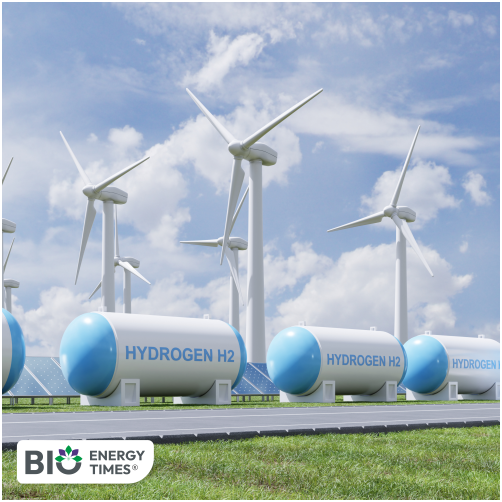
Germany has launched two pilot projects in Chile and Ghana to promote green hydrogen and fuel cell technologies for decentralised energy supply, with a focus on data centre power requirements and energy storage solutions, Hydrogen Central reported.
The H2Datacenter project began in Chile on October 1, 2026, while the H2Scale project was launched in Ghana on November 1. Both projects are funded under the Export Initiative Environmental Protection (EXI) of Germany’s Federal Ministry for the Environment, Climate Protection and Nuclear Safety (BMUKN).

The projects are part of EXI’s programme on green hydrogen and fuel cell technologies for decentralised energy supply. The initiative also has 13 completed projects and four others under implementation, covering pilot projects, feasibility studies and activities involving German chambers of commerce abroad.
Nilgün Parker, head of the GII3 division at BMUKN, said the two projects would expand the EXI portfolio and strengthen its international focus. While H2Datacenter will examine the potential of green hydrogen for supplying energy to data centres, H2Scale will develop a standardised power-to-power container solution suited to the African market. The latter will also explore innovative business models and ways to reduce costs.
Dagmar Fehler, CEO and spokesperson of NOW GmbH, said the organisation was supporting BMUKN in promoting the international adoption of sustainable, decentralised energy solutions from Germany.
She said H2Datacenter would advance new energy supply technologies while supporting digitalisation and data-driven operations. H2Scale, meanwhile, would provide experience in scaling up such solutions, benefiting German companies, the environment and local communities.
Hydrogen-based power supply for data centres
Under H2Datacenter, Germany’s Reiner Lemoine Institute (RLI) and H2 Powercell GmbH are working on ways to address the growing demand for renewable energy at data centres.
A site operated by Patagonian Datco will serve as the project’s pilot location. The aim is to develop an energy supply system that is sustainable and as self-sufficient as possible.
The proposed system will combine an electrolyser, hydrogen storage and a fuel cell. It will use electricity generated by solar photovoltaic panels to produce green hydrogen, which can then be converted back into electricity when required.
The power-to-power system will be tested for emergency electricity supply at the data centre and as an additional energy storage solution.