

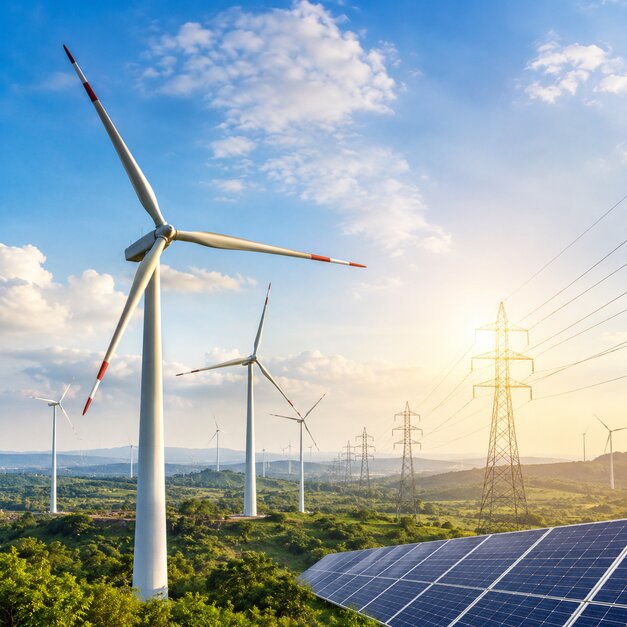
New Delhi: The Union Cabinet on Wednesday approved the Rs 1.86 lakh crore Green Energy Corridor Phase-III (GEC-III) scheme to develop transmission infrastructure for evacuating up to 135 GW of renewable power and deploy 50 GWh of battery energy storage capacity, ANI reported.
Union Minister Ashwini Vaishnaw, while announcing the Cabinet decision, said strengthening transmission infrastructure was essential to support the country’s growing renewable energy capacity. The government intends to ensure that transmission systems are developed ahead of new renewable energy projects.

A presentation made during the Cabinet briefing noted that insufficient transmission infrastructure could lead to curtailment of renewable power. It stressed that transmission capacity needs to be created before additional renewable generation capacity comes online.
The scheme has a total outlay of Rs 1,86,405 crore and is scheduled to be completed by FY 2032-33. Of the total amount, Rs 1,36,378 crore will be used to strengthen intra-state transmission systems, while Rs 50,000 crore has been allocated for the deployment of 50 GWh of Battery Energy Storage Systems (BESS). The Centre will provide financial assistance of Rs 54,082 crore.
The government said GEC-III will facilitate the evacuation of up to 135 GW of renewable power across states and Union Territories.
The battery storage systems may be installed at renewable energy generation sites or at other locations identified as important for improving grid flexibility. According to the Cabinet release, the storage capacity will help manage renewable power intermittency, transmission congestion, peak-hour curtailment and electricity demand during non-solar hours.
Solar and wind power generation varies with sunlight and wind conditions, unlike conventional power generation. As renewable capacity increases, stronger transmission networks and storage systems are therefore needed to balance electricity supply and demand.
According to Vaishnaw’s presentation, India is targeting 500 GW of non-fossil fuel capacity by 2030 and around 786 GW by 2035-36. The Cabinet release also stated that the scheme would support the longer-term target of 900 GW of installed non-fossil capacity by 2035.
The rapid growth of solar power capacity has also increased the need for supporting transmission infrastructure. An official PIB backgrounder said India’s installed solar capacity stood at 162.15 GW as of June 30, 2026, compared with around 3 GW in 2014.
Under GEC-III, all new or greenfield intra-state transmission projects will be awarded through tariff-based competitive bidding. Transmission service providers selected through the process will build, own, operate and maintain the transmission assets, while State Transmission Utilities will act as the overall implementing agencies.
The upgradation and strengthening of existing, or brownfield, transmission networks will be undertaken on a cost-plus basis.
The government said central financial assistance would help offset intra-state transmission charges and reduce their impact on electricity costs for consumers.
GEC-III marks a significant expansion of India’s Green Energy Corridor programme, which was originally introduced to strengthen transmission networks in states with high renewable energy potential.
With renewable generation capacity expanding rapidly, the programme places greater emphasis not only on adding generation capacity but also on ensuring that renewable electricity can be transmitted, stored and supplied when required.













