
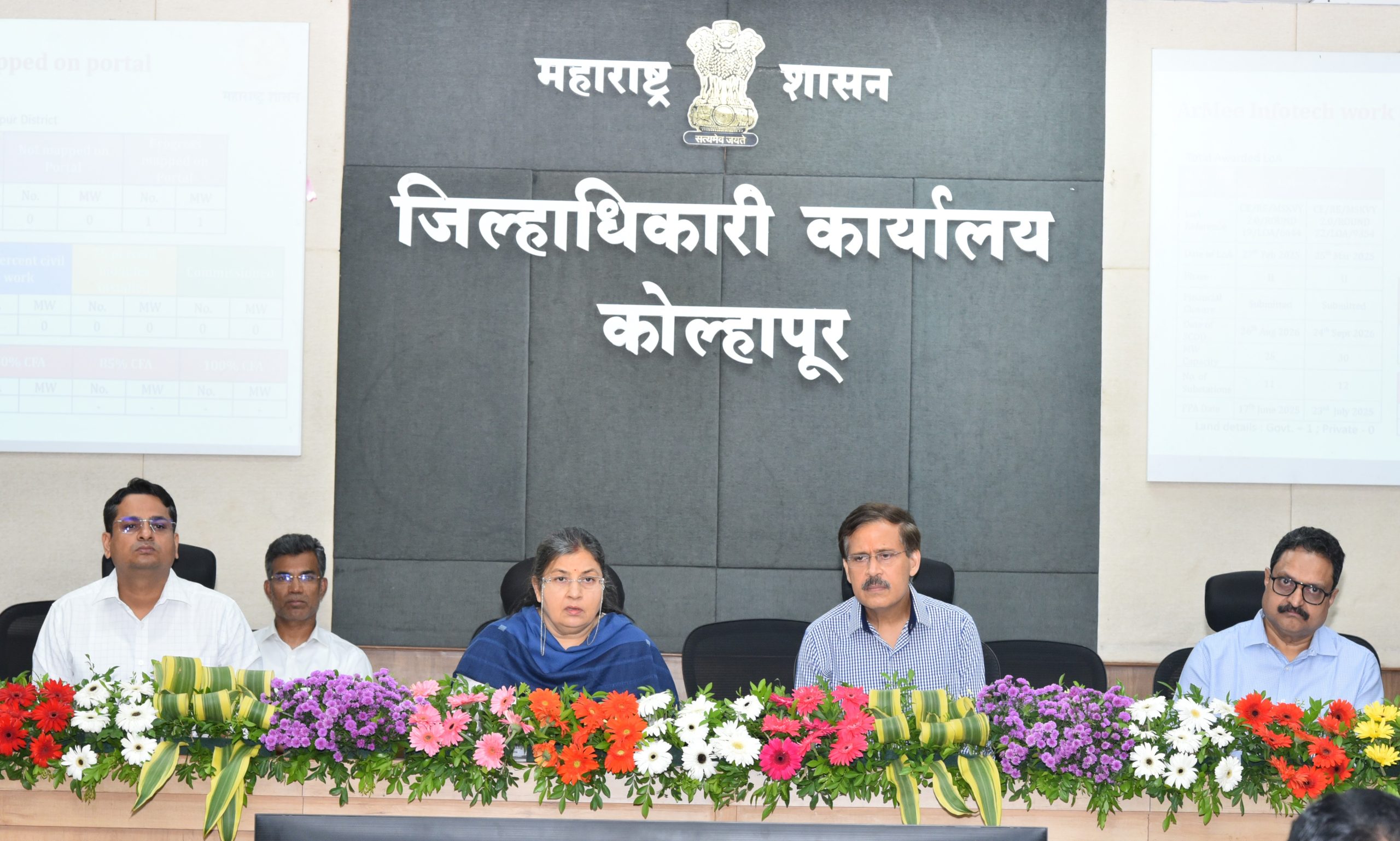
Kolhapur: The Mukhyamantri Saur Krishi Vahini Yojana 2.0, launched on the initiative of Chief Minister Devendra Fadnavis, has become a model for other states across the country. Additional Chief Secretary (Energy) Abha Shukla directed Mahavitaran employees that contractors must complete all projects within the stipulated time so that farmers can receive daytime electricity, failing which their security deposits will be forfeited. She also instructed that solar panels be installed on as many government offices as possible, that agencies upload all work updates on the portal, and that land not required under the scheme be returned to the government. She was speaking at a district-level Task Force review meeting held at the Maharani Tararani Sabhagruh in the Collector’s office.
Present at the meeting were Lokesh Chandra, Additional Secretary to the Chief Minister’s Office and Chairman and Managing Director of Mahavitaran, District Collector Dr. Vijay Rathod, Chief Executive Officer Dr. Jasmine, Superintendent of Police Nilotpal Basu, Director (Operations) Sachin Talewar, Pune Regional Director Sunil Kakade, Solar Agro Company Consultant Shrikant Jaltare, Chief Engineer of Kolhapur Circle Swapnil Katkar, Mahaniramiti Chief Engineer Sanjay Kurhade, Special Executive Officer Mangesh Kohat, Superintending Engineers Ganpat Latpate, Amit Bokil, Punam Rokade, Electrical Inspector Salim Sutar, and MEDA representative Jayandra Wadunkar.

Abha Shukla further stated that daytime electricity supply to agriculture is being provided through the world’s largest decentralised solar energy projects. Maharashtra has now reached second place in non-conventional energy generation. In the installation of off-grid solar pumps, the state is ranked first in the country with 69 percent of the work completed. Overall, solar energy generation in the state has seen significant growth, and the Maharashtra Electricity Regulatory Commission has ensured that the benefits of multi-year electricity tariff hearings have reached everyone.
Speaking on the occasion, Mahavitaran Chairman and Managing Director Lokesh Chandra said that public participation in the Prime Minister Suryaghar Yojana should be increased, more villages in the district should be brought under the Saurgram scheme, and the work of installing solar panels in 80 offices across the district should be taken to 100 percent completion. He also stressed the need to recover pending dues from water supply schemes, and said that the goal is to meet more than 50 percent of the state’s electricity requirement through non-conventional energy sources in the coming years.
Dialogue with Industrial Consumer Organisations
While interacting with industrial consumers, Lokesh Chandra said that if industries work on improving their load factor, both sides stand to benefit. Mahavitaran has set up 400 megawatts of solar storage capacity in the state, with a future target of scaling it up to 12,000 megawatts. He added that if electricity consumers also work on storage batteries to save solar electricity, they will benefit even more in the future, though currently the number of such consumers remains very small. He noted that with the agricultural company separating from Mahavitaran, the burden of cross-subsidy on industries will reduce in the future. He also assured industries that carbon emission-free electricity usage certificates will be provided on demand, and that local issues will be resolved within the next two months.
Lokesh Chandra praised the work of the Kolhapur circle. He mentioned that smart meters have been installed for approximately 1.42 crore electricity consumers across the state, and made it a point to clarify that these smart meters are not prepaid. He noted that before smart meters were installed, around 12 percent of complaints were related to electricity registration and billing, and that figure has now become negligible. Contractors of the Saur Krishi Vahini Yojana 2.0 from Kolhapur and Sangli districts, representatives of industrial consumer organisations, all executive engineers, departmental heads, sub-divisional officers, and employees were present in large numbers at the meeting.