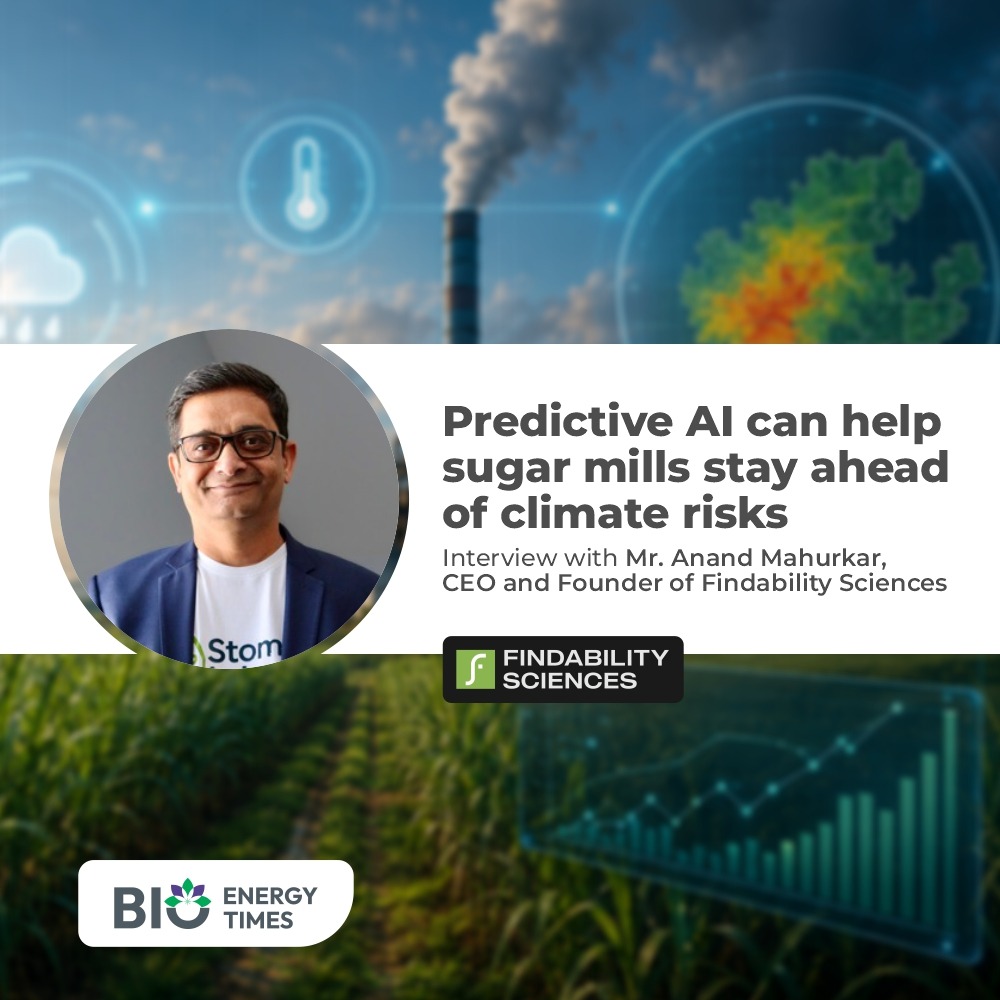
Artificial intelligence is set to reshape India’s sugar industry by enabling mills to forecast sugarcane yields, optimise ethanol diversion and respond to climate risks in real time, according to Anand Mahurkar, CEO and Founder of Findability Sciences. In this interview, he explains how predictive intelligence can help sugar mills improve efficiency, strengthen profitability and make faster, data-driven decisions across the value chain.
Q1. How can AI-powered forecasting help predict sugarcane yields and mitigate climate-related risks?

The sugar industry has been sitting on data for decades, soil records, weather patterns, cane variety performance, mill intake history. What was missing was the ability to turn that into foresight. AI-powered forecasting changes that. At Stomata Labs, our Stoma Sense platform combines satellite imagery, weather models, and ground-level farm data to predict yield at a plot level, months before harvest, not industry averages, actual field-by-field intelligence. When a mill knows three months out that a cluster of farms is tracking 15-20% below expected yield due to moisture stress, they can act — irrigation advisories, crop insurance triggers, procurement planning. That’s the shift: from reacting to a bad season after the fact, to managing risk while there’s still time to change the outcome.
Q2. What role can predictive analytics play in helping sugar mills balance sugar production and ethanol diversion decisions?
This is one of the highest-stakes decisions a mill CEO makes every season, and today it’s still made with incomplete information. Sugar prices, ethanol offtake commitments, molasses yield, government policy signals, these move independently, but the diversion decision needs to account for all of them simultaneously. Predictive analytics gives mills a live model of that trade-off instead of a static one built on last year’s numbers. With Stoma Insight, we help mills simulate diversion scenarios against real-time price and demand signals, so the decision isn’t just “what worked last season” — it’s “what maximizes realization this season, given where markets and mandates actually are today.” Given India’s push toward its ethanol blending targets, mills that get this balance right aren’t just protecting margins, they’re positioning themselves as reliable long-term partners in the country’s energy transition.
Q3. How can real-time operational intelligence enable faster and more informed decision-making across the sugar value chain?
The sugar value chain has always generated enormous operational data, crushing rates, recovery percentages, boiler efficiency, cane queue times. Historically, that data sat in disconnected systems and reached decision-makers days too late to matter. Real-time intelligence closes that gap. When a mill can see recovery dropping on the crushing floor as it happens, not in next week’s MIS report, they can course-correct the same shift. That’s the difference between a 0.2% recovery loss and a 2% one over a season, and at scale, that’s the difference between a good year and a great one. What we’re building with Stoma Insight is essentially a live nervous system for the mill, connecting field, factory floor, and finance so decisions get made at the speed the business actually operates.
Q4. In what ways can AI and advanced analytics improve operational efficiency, profitability, and resource planning for sugar mills?
Sugar milling is a business of thin margins and heavy fixed costs, which means efficiency isn’t a nice-to-have — it’s survival. AI’s real contribution here isn’t flashy dashboards, it’s precision: predicting maintenance before a breakdown halt crushing, optimizing energy and steam usage across the plant, matching manpower and logistics planning to actual cane arrival patterns instead of estimates. Each of these is a small percentage gain individually. Stacked across a full season, they add up to real money and real capacity. We’ve consistently seen that mills willing to treat their own operational data as an asset, rather than a compliance byproduct, unlock efficiency gains that no amount of capital expenditure alone would deliver. That’s the mindset shift the industry needs, more than any single piece of technology.
Q5. How can predictive intelligence help the sugar industry prepare for weather-related disruptions and supply fluctuations?
Weather has always been the sugar industry’s biggest uncontrollable variable, but “uncontrollable” doesn’t mean “unpredictable.” With the right models, mills and farmers can get meaningful lead time on drought stress, excess rainfall, or pest outbreaks tied to weather patterns, and that lead time is everything. It’s the difference between scrambling for cane after a shortfall and having already adjusted procurement, contracts, and ethanol allocation weeks in advance. As climate variability increases across India’s cane-growing belts, this kind of forward intelligence stops being a competitive edge and starts being a baseline requirement for running a resilient mill. The industry that plans around the data it already has will always outperform the one that waits for the season to tell it what went wrong.