
Building a commercially viable compressed biogas (CBG) plant requires more than investment in machinery and production infrastructure. Developers need to secure a reliable supply of organic waste, select technology suited to the available feedstock, identify buyers for the gas and establish markets for the organic manure generated during production.
India’s CBG sector has evolved from household biogas installations into a commercial renewable energy industry, supported by initiatives such as the Sustainable Alternative Towards Affordable Transportation (SATAT), launched in 2018, and the GOBARdhan initiative. The focus is increasingly shifting towards an integrated business model that connects agricultural waste management with renewable fuel production and organic fertiliser.

What began primarily as an effort to create a market for CBG has gradually developed into a broader ecosystem encompassing biomass, waste management, renewable energy, agriculture and resource recovery.
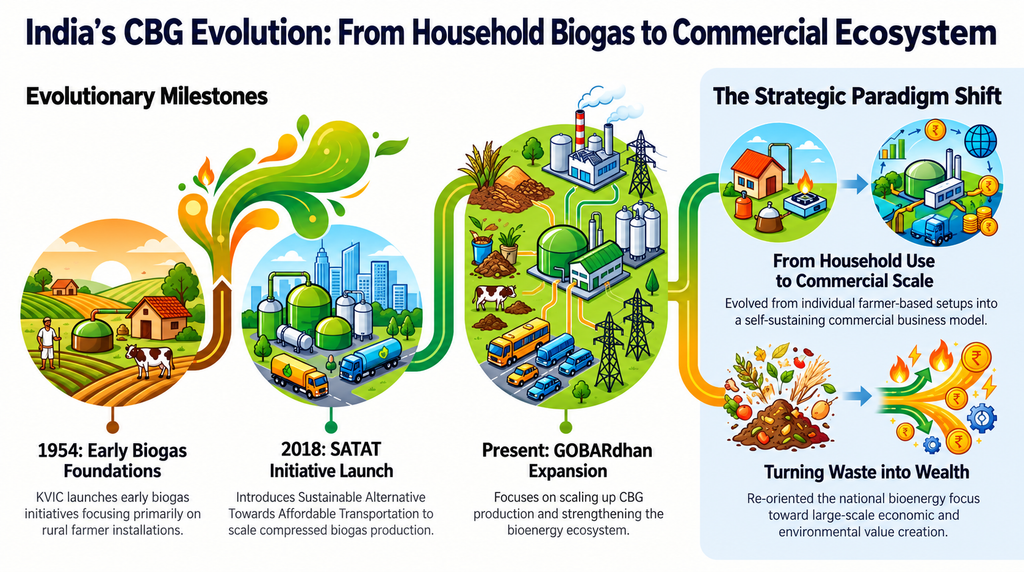
Developments in the GOBARdhan initiative, along with growing attention to feedstock management, gas offtake, financing and project execution, have changed how CBG projects need to be evaluated. For prospective investors and entrepreneurs, the key question is no longer simply whether CBG can be produced, but whether a reliable, commercially viable and sustainable renewable-gas ecosystem can be built around the available feedstock.
This calls for a broader assessment of a CBG project, extending beyond financial viability to include the development of an integrated ecosystem capable of ensuring uninterrupted operations, efficient production and long-term profitability.
CBG Production Business: From creating a market to building an ecosystem
One of the key objectives of the Sustainable Alternative Towards Affordable Transportation (SATAT) scheme was to promote domestic CBG production by encouraging entrepreneurs to set up CBG plants and oil marketing companies (OMCs) to procure the gas.
India has considerable potential for CBG production, given the availability of agricultural residues, cattle dung, municipal waste and industrial organic waste. These feedstocks can be converted into biogas, which is subsequently purified and upgraded into compressed biogas.
The initiative provided an important policy push to the sector, promoting CBG as a commercially viable renewable fuel and encouraging investment in project development. It also brought together key stakeholders, including feedstock suppliers, technology providers, financial institutions, OMCs and entrepreneurs.
A CBG plant is only as strong as the ecosystem around it
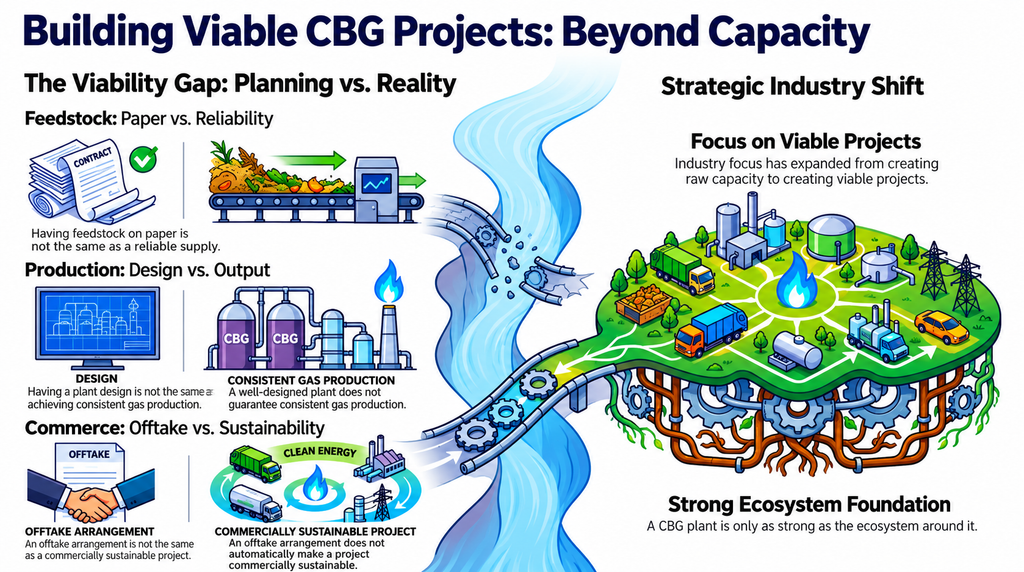
However, the industry’s experience over the years has highlighted a fundamental reality: the success of a CBG plant depends as much on the ecosystem supporting it as on the plant itself.
Identifying available feedstock does not necessarily guarantee a reliable supply throughout the year. Similarly, an established plant design does not ensure consistent gas production, while an offtake agreement alone cannot guarantee commercial viability.
A project’s success ultimately depends on how effectively these elements work together, from feedstock sourcing and processing to gas production, marketing and by-product utilisation. Consequently, the industry’s focus is gradually shifting from simply creating CBG production capacity to developing commercially viable projects backed by a reliable and integrated ecosystem.
Where GOBARdhan changes the conversation
The GOBARdhan initiative broadens the scope of India’s CBG ecosystem by promoting the scientific management and productive utilisation of organic waste.
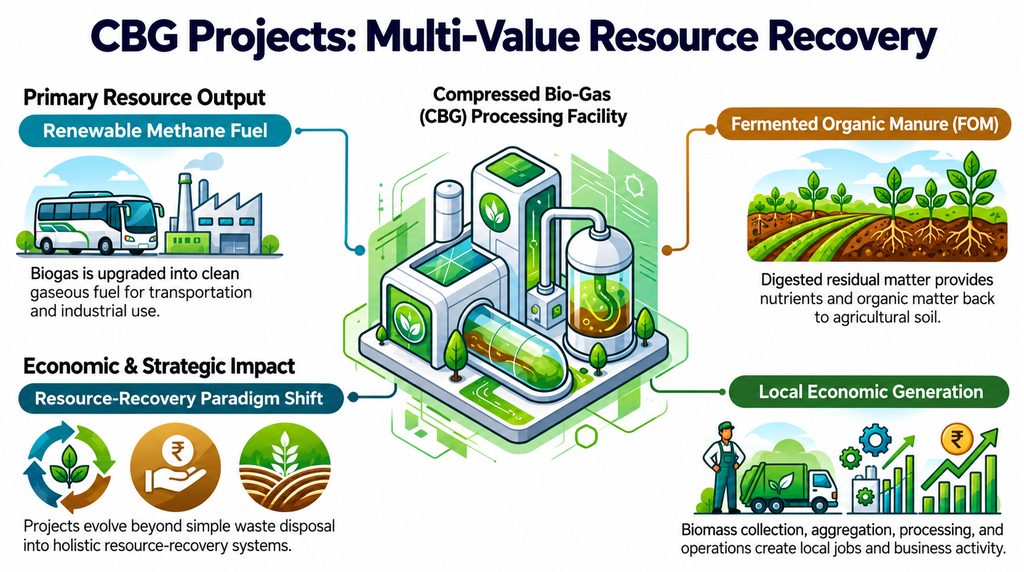
Its objective is to convert organic waste into valuable resources, particularly compressed biogas (CBG) and organic manure, linking waste management with renewable energy production and agricultural sustainability.
This takes the focus beyond fuel production. A well-integrated CBG project can deliver multiple benefits by generating renewable energy, improving organic waste management and producing nutrient-rich manure for agricultural use.
A successful CBG project can potentially address several objectives at the same time.
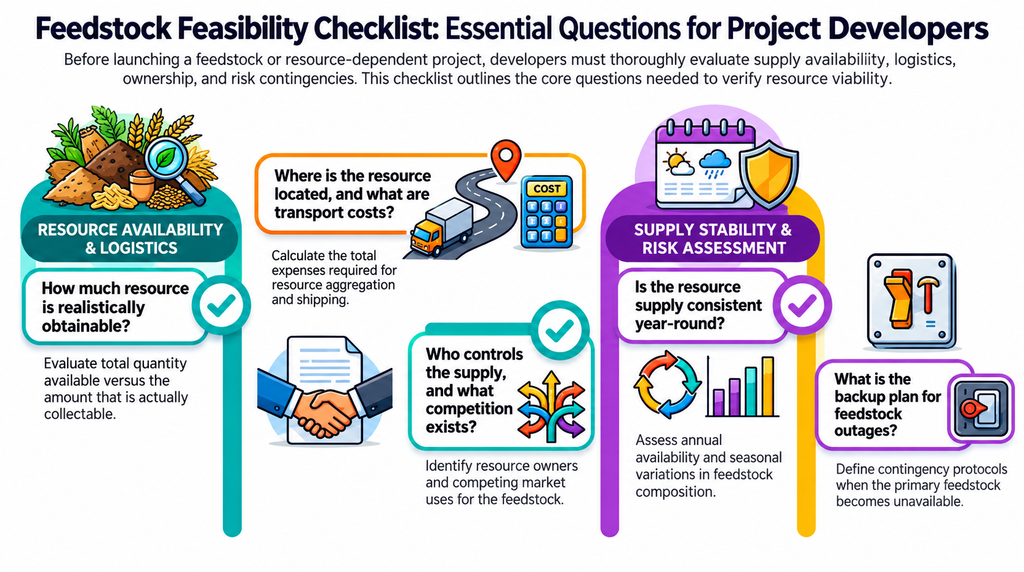
For any developer planning a compressed biogas (CBG) project, one of the first questions to address is the availability and suitability of the feedstock.
What is the feedstock?
India has considerable quantities of biomass and organic waste. However, availability at the national or state level does not necessarily translate into reliable supplies at the plant gate.
A project needs to establish how much feedstock is available, where it is located and whether it can be sourced throughout the year. Developers must also assess how much can actually be collected, who owns or controls it, and whether there are competing uses for the material.
Three other factors are equally important. The first is the cost of collecting and transporting the feedstock. The second is how its composition varies throughout the year. The third is the availability of alternative feedstock during periods when the primary source is unavailable. All these factors can significantly influence plant economics and apply to both agricultural and agro-industrial feedstocks.
A sugar mill, for instance, may have access to press mud and spent wash, while a rice-growing region may produce large quantities of rice straw. However, these feedstocks can differ significantly in their characteristics, seasonality, logistics and competing uses.
Feedstock assessment, therefore, needs to go beyond measuring quantity to evaluating quality and reliability of supply. The objective is not merely to establish that biomass exists, but to ensure that the right material can reach the plant in the required quantity and quality at an economically viable cost.
The plant itself is only one part of the equation
As the CBG ecosystem matures, selecting the right technology has become just as important as securing a reliable feedstock supply. Different feedstocks behave differently during anaerobic digestion. Factors such as moisture, total solids, volatile solids, biodegradability and contaminants can influence digestion efficiency and, ultimately, methane production.
Consequently, a technology designed for one type of feedstock may not be suitable for another. Developers need to assess the expected methane yield, the stability of the digestion process and how variations in feedstock composition will be managed. Other important considerations include the level of pretreatment required, the treatment of hydrogen sulphide (H₂S) and other impurities, and the choice of gas-upgrading technology. Developers must also plan for the management of digestate and Fermented Organic Manure (FOM), as well as determine the appropriate level of plant automation and monitoring.
These may appear to be technical considerations, but they ultimately have commercial implications. Even a difference of a few percentage points in plant performance, methane recovery, energy consumption or feedstock requirements can significantly affect project economics over the plant’s operating life.
The economics are bigger than the CBG price
The economics of a CBG plant also extend well beyond the price of gas. A project’s revenue potential cannot be assessed solely on the income generated from selling renewable methane, as it can derive value from multiple sources.
Overall project economics can be shaped by three distinct revenue streams. The first and most important is CBG, or renewable methane, which is the primary energy product and the main source of revenue.
The second comes from the digested organic material, which can be further processed into Fermented Organic Manure (FOM) and Liquid Fermented Organic Manure (LFOM). This creates additional value from digestate and opens up potential revenue streams from nutrient-rich co-products.
The third is the value generated through waste management. Where a project processes an existing stream of organic waste, the economic value associated with its responsible treatment and disposal can also contribute to the project’s overall viability.
On the cost side, the main drivers include feedstock collection and transportation, pretreatment, energy and water consumption, gas upgrading and compression, operations and maintenance, and digestate handling for FOM and LFOM production.
Together, these factors make every CBG project different. Two plants with identical CBG production capacities can have significantly different economics depending on their feedstock, location, logistics and operating models.
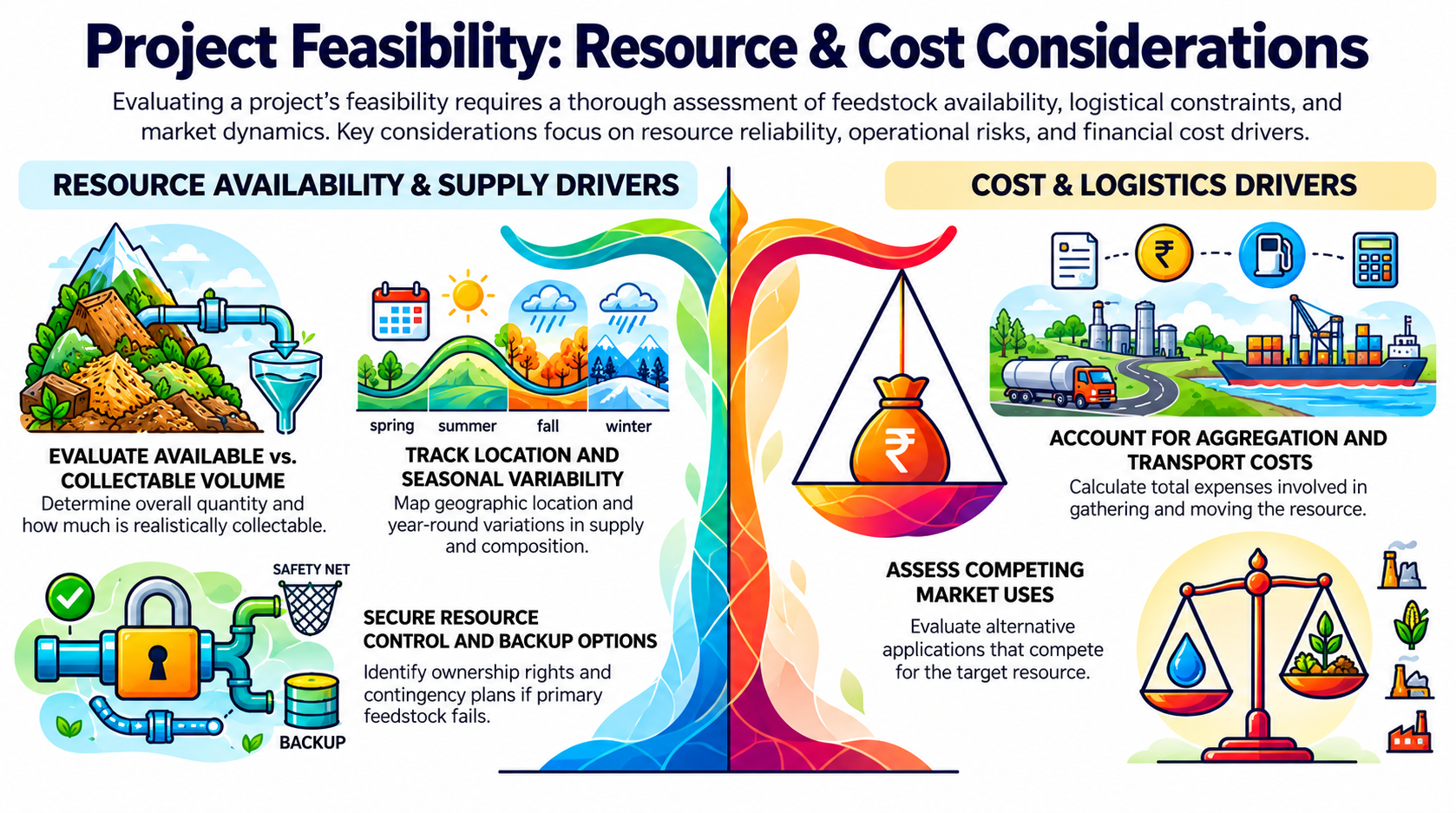
Understanding the economics of methane production across different feedstocks
The more useful question when evaluating a project, therefore, is not how much a CBG plant costs, but how much it costs to reliably produce each unit of renewable methane from a specific feedstock. This provides a more meaningful starting point for assessing project economics.
FOM is also becoming an increasingly important part of the CBG business model. One of its key features is that the production process does not end once the gas leaves the plant.
Anaerobic digestion breaks down biodegradable organic matter to produce biogas, while the residual material can be further processed into FOM. This creates an opportunity to build a more circular business model.

For developers, this raises several additional questions. They need to assess the quality and consistency of the FOM, the size of the local market and the standards and requirements it must meet. They must also plan how it will be processed, stored and transported, and how its value can be factored into the overall project economics.
These considerations are particularly important for projects closely linked to the farming ecosystem. From this perspective, a CBG plant can be viewed as a resource-recovery platform rather than simply a facility for producing gas.
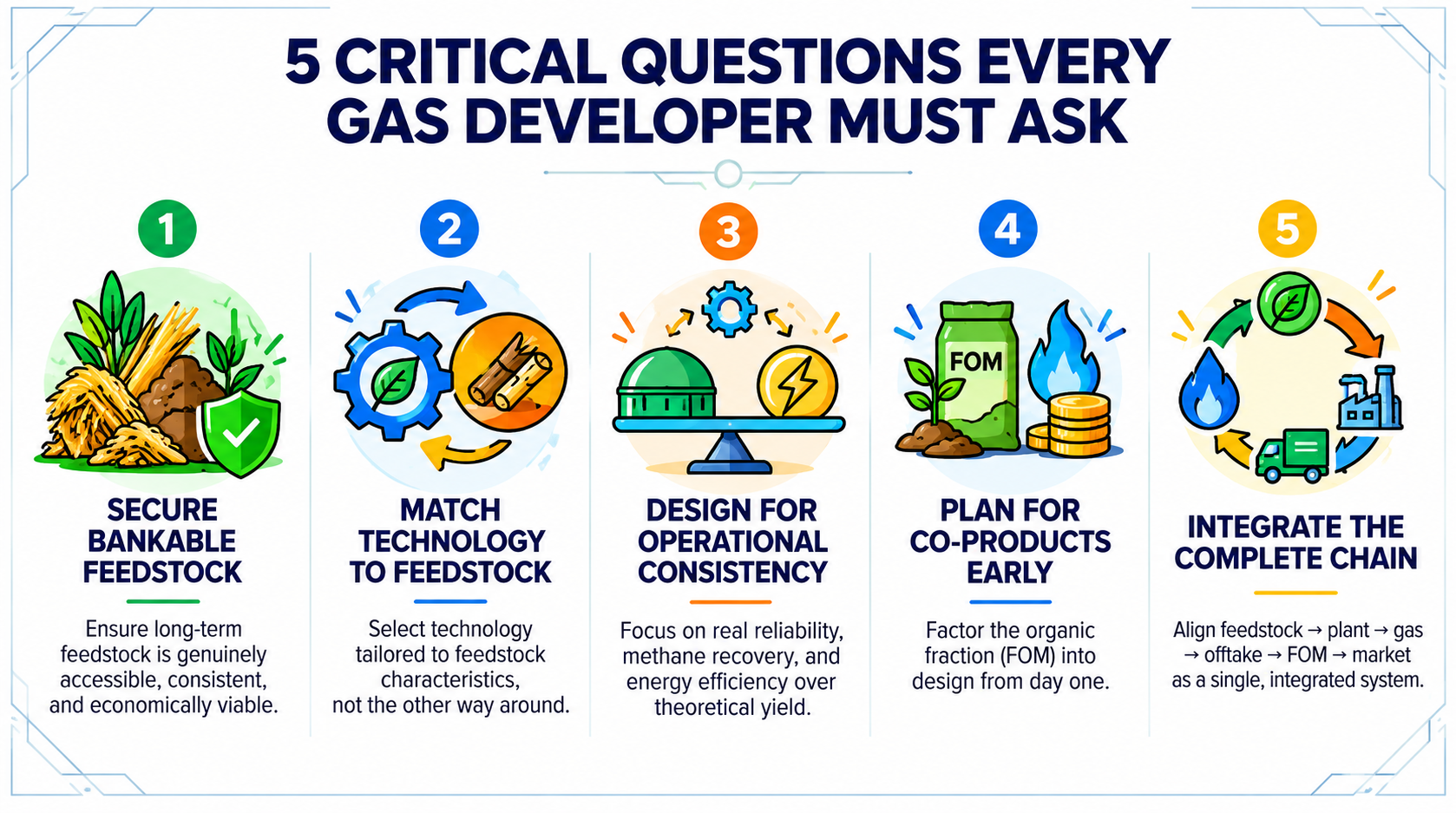
Five questions every developer should ask
The first is whether the feedstock is genuinely bankable. It must be accessible, consistently available and economically viable, rather than merely present in the region.
The second is whether the technology is suited to the feedstock. Technology selection must be guided by the characteristics of the available feedstock, not the other way around.
The third is whether the plant is designed to deliver consistent performance. Theoretical gas yield is only one part of the equation; operational reliability, methane recovery and energy consumption are equally important.
The fourth concerns the utilisation of the organic fraction. FOM and other co-products should be factored into project planning from the outset rather than treated as an afterthought once the plant has been designed.
The fifth is whether the entire value chain is commercially viable. This includes every stage, from feedstock sourcing and processing to gas production and offtake, as well as FOM production and marketing. A successful project requires all these elements to work together.
A strong project needs all of these links to work together.
| From CBG project to integrated biorefinery |
Sugar mills, distilleries, food-processing companies, agricultural enterprises and other businesses that already handle large volumes of organic waste can explore CBG as part of a broader resource-integration strategy. The future of CBG does not lie in building standalone gas plants; it increasingly lies in integrating renewable gas production into existing agricultural and industrial ecosystems.
For a prospective developer, the next step is to undertake a structured assessment of the available resource and the opportunity it presents. This begins with understanding the feedstock, assessing its availability and characteristics, and evaluating the associated logistics.
Developers must then determine the appropriate biological and process configuration, estimate methane potential and operating requirements, and assess the scope for producing FOM and other co-products. Only after these factors have been evaluated should the overall commercial model be developed.
This approach changes the conversation. The question is no longer, “We have biomass. Can we build a CBG plant?” but rather, “We have a resource. What is the best way to create value from it?”
That is a far more useful question and, increasingly, one that will distinguish commercially viable projects from proposals that merely look attractive.
Where technology becomes a differentiator
As the market matures, technology will play an increasingly important role in determining project performance. Praj’s rengas® platform combines feedstock-specific biological solutions, anaerobic digestion, gas purification and integrated plant engineering to develop renewable gas solutions tailored to the characteristics of the available resource. Its objective is simple: to build the process around the feedstock.
For organisations evaluating a CBG opportunity, assessing the resource, process and economics together is a useful starting point. However, projects that create lasting value will be those that get the fundamentals right across feedstock, technology, economics, operations and markets.
When these elements work together, CBG can become more than an alternative fuel. It can become a meaningful part of India’s circular bioeconomy.
Praj’s rengas® platform brings together feedstock-specific biological solutions, anaerobic digestion, gas purification and integrated plant engineering to develop renewable gas solutions tailored to the characteristics of the available resource.
The objective is simple: Build the process around the feedstock.
For organisations evaluating a CBG opportunity, understanding the resource, the process and the economics together is a useful starting point.
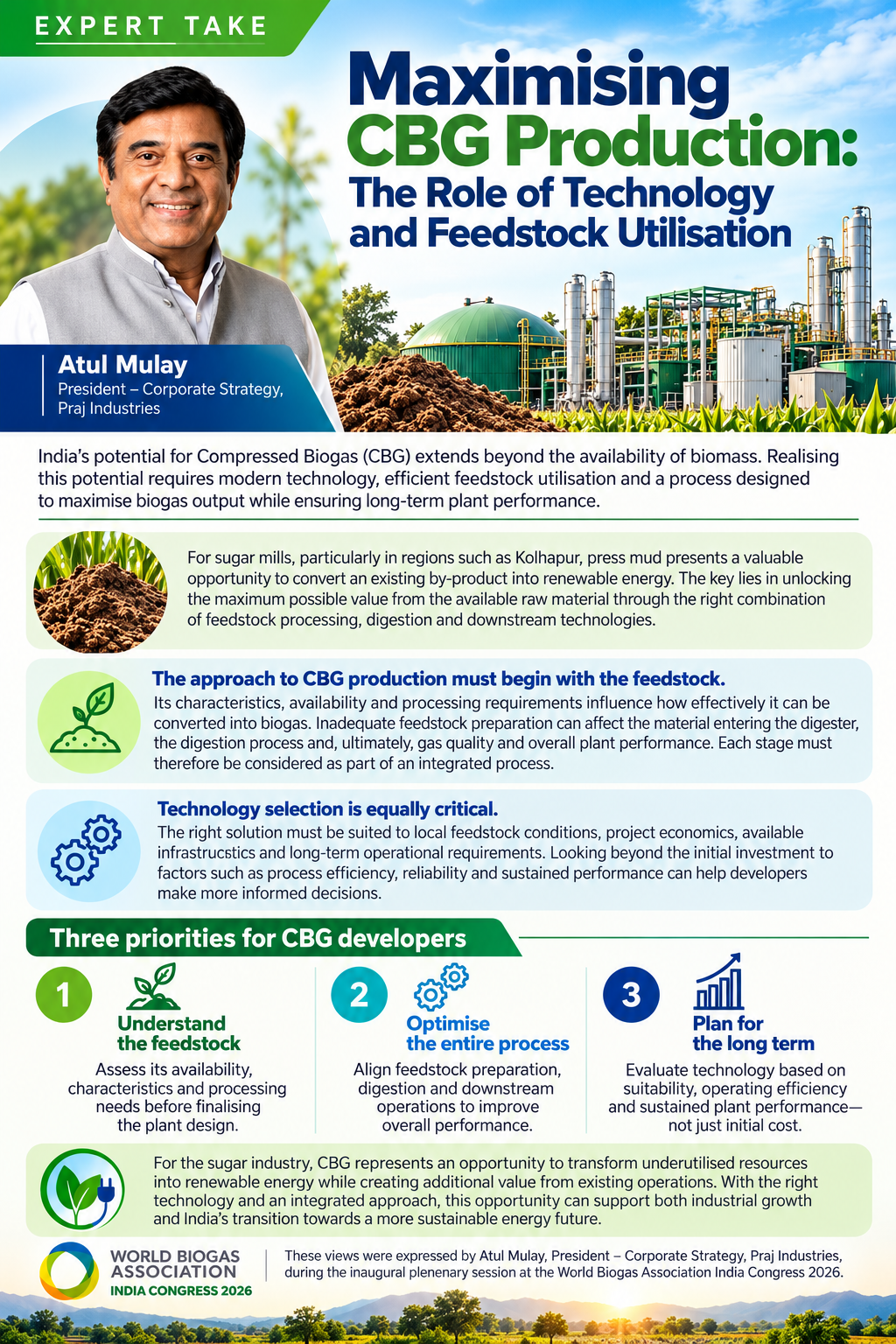
In a nutshell: Maximising CBG production through feedstock and technology optimisation