

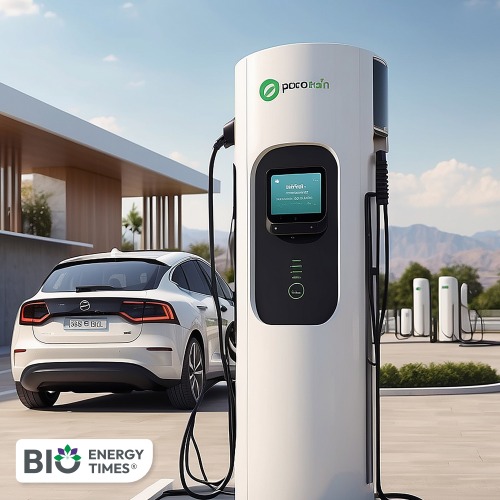
Chinese electric vehicle makers are stepping up the race to develop ultra-fast charging technology, aiming to reduce charging times to levels closer to those of conventional petrol and diesel refuelling, Reuters reported.
Companies including Geely, BYD and Li Auto are developing systems that can deliver hundreds of kilometres of range within minutes. The push comes as automakers look for ways to address consumer concerns over driving range and support EV demand in China, where market growth has slowed.

However, delivering electricity at megawatt-level power to lithium-ion batteries creates significant technical challenges. Managing heat, battery life and safety while ensuring that charging infrastructure can handle the increased power demand remains a major challenge.
Chinese manufacturers have moved ahead of several Western automakers in charging speeds.
Geely on Wednesday unveiled an ultra-fast charging system with a specialised battery and a peak output of up to 2.25 megawatts (MW) from a single charging gun. The company said the system can charge an EV from 10% to 70% in 4.5 minutes and from 10% to 97% in 8 minutes and 40 seconds at room temperature.
BYD has also developed megawatt-level charging systems and blade batteries that can charge from 10% to 97% in about nine minutes.
Li Auto’s flagship electric vehicles use CATL’s 5C Kirin battery, which can add up to 500 km of driving range in around 12 minutes.
Battery manufacturer Sunwoda has also entered the ultra-fast charging race with a system that it says can charge a battery from 10% to 97% in nine minutes.
By comparison, a typical 10% to 80% charge using a Tesla Supercharger takes around 15 to 25 minutes. Mercedes-Benz says its fast-charging system can charge from 10% to 80% in as little as 22 minutes.
The higher charging speeds bring greater challenges in controlling battery temperature and limiting degradation.
Chinese automakers are using advanced cooling systems, battery designs and software to manage the additional heat generated during ultra-fast charging.
Geely has introduced a full-loop, five-end liquid-cooling system that circulates coolant through the charging station’s storage batteries, liquid-cooled cables and vehicle charging ports.
Manufacturers are also modifying battery cell designs to reduce resistance and heat generation. Some are using shorter cells or short-blade designs to help manage temperatures during high-power charging.
Software is also being used to improve safety. Geely is deploying an artificial intelligence system based on deep-learning algorithms that runs in the vehicle and can predict a rise in battery temperature up to 30 seconds in advance.
Automakers and battery manufacturers are also using technologies such as specialised coatings and high-frequency pulse currents to reduce battery degradation caused by repeated fast charging.
Despite rapid progress, charging speeds may already be approaching a practical limit, according to a Geely executive cited by Reuters. The focus could therefore increasingly shift from simply increasing charging power to expanding the infrastructure needed to support ultra-fast charging.
Multi-megawatt charging could place significant demands on electricity networks. To manage this, charging stations are being combined with battery storage systems and solar power installations.
BYD plans to build 90,000 flash-charging stations by 2028 and install 300 such stations in the UK over the next year.
Another approach is battery swapping. NIO has more than 4,000 battery-swap stations, where a depleted battery can be replaced with a fully charged one in about three minutes.
The developments indicate that the next phase of competition in the EV market is increasingly shifting from vehicle range alone to how quickly drivers can recharge or replace their batteries, according to Reuters.













