
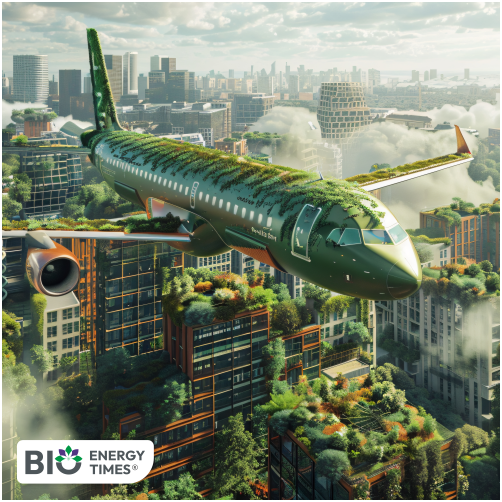
Memphis: FedEx is expanding its sustainable aviation fuel (SAF) procurement, with new agreements expected to secure more than 20 million gallons of neat SAF through 2027 as the air-cargo company seeks to reduce emissions from aviation, its largest source of direct carbon emissions, Carbon Credits reported.
The agreements announced on September 15 cover five US airports — Newark Liberty International Airport, Oakland International Airport, Miami International Airport, John F. Kennedy International Airport and Dallas-Fort Worth International Airport.

Depending on the airport, the SAF will be supplied at blend ratios ranging from 30% to 50%. The new agreements build on around 5 million gallons of neat SAF secured by FedEx in 2025, which supported the deployment of 16.5 million gallons of blended SAF across five US airports.
The expanded procurement forms part of FedEx’s strategy to achieve carbon-neutral operations by 2040. The company’s target covers Scope 1 and Scope 2 emissions from its operations, as well as Scope 3 emissions associated with contracted transportation.
SAF, aircraft modernisation and operational efficiency are among the measures included in the company’s broader climate strategy.
FedEx Chief Sustainability Officer and Vice-President of Environmental Affairs Karen Blanks Ellis said expanding SAF procurement would enable the company to increase its use of the fuel while supporting greater production and scale in the market.
Aviation accounted for the largest share of FedEx’s direct emissions in fiscal 2025. The company reported 13.93 million metric tonnes of CO2e in Scope 1 emissions, with owned aircraft accounting for about 79% of the total. Aviation fuel consumption generated roughly 11 million metric tonnes of CO2e during the year.
FedEx reported another 952,744 metric tonnes of Scope 2 emissions, primarily from purchased electricity, while reported Scope 3 emissions stood at 14.88 million metric tonnes of CO2e.
Combined reported Scope 1, Scope 2 and Scope 3 emissions totalled 29.76 million metric tonnes of CO2e in FY2025. FedEx said its Scope 3 inventory continues to expand and therefore does not represent every possible Scope 3 emissions category.
The company also reported emissions of conventional air pollutants in 2025, including around 71,432 metric tonnes of nitrogen oxides (NOx), 10,773 metric tonnes of sulfur oxides (SOx) and 640 metric tonnes of particulate matter (PM10). These pollutants are reported separately from its greenhouse-gas emissions inventory.
The latest SAF agreements are expected to increase the availability and use of lower-carbon aviation fuel across FedEx’s US air network while adding demand for SAF production capacity.