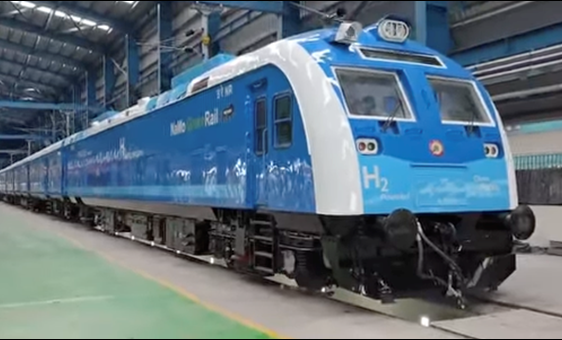
New Delhi: Indian Railways is exploring ways to reduce the cost of green hydrogen as it looks to expand hydrogen-powered train operations, less than a month after launching the country’s first such train.
The railways is considering several measures to increase the number of green hydrogen suppliers and lower procurement costs. One option under consideration is assuring producers of a certain level of demand, according to officials, The Times of India reported.

India’s hydrogen train had completed more than 2,500 km of commercial operations by early August after services began in mid-July, according to official estimates.
The country currently operates what it describes as the world’s most powerful hydrogen train and has also set up a dedicated facility to produce and supply hydrogen for the service.
Indian Railways initially plans to introduce 35 hydrogen-powered trains on heritage routes. Many of these routes pass through hilly areas where conventional railway electrification may not be practical.
Focus on reducing hydrogen costs
“Green hydrogen supply costs need to come down to ensure wider adoption of hydrogen trains,” a senior government official said, adding that several options were being examined.
The government is already offering incentives for electrolyser manufacturing and green hydrogen production under a dedicated programme.
The National Green Hydrogen Mission, with an allocation of Rs 17,490 crore until 2029-30, also aims to create opportunities for exports.
India has set a target of developing 5 million tonnes of annual green hydrogen production capacity by 2030.
In February, India recorded its lowest discovered price for green hydrogen at Rs 279 per kg, or about $3.08, in a tender to supply 10,000 tonnes a year to Numaligarh Refinery in Assam.
Former NITI Aayog CEO Amitabh Kant said government incentives and cheaper renewable electricity were helping bring down production costs. He said green hydrogen at $2 per kg was becoming increasingly achievable.
How India’s hydrogen train works
Prime Minister Narendra Modi flagged off India’s first hydrogen-powered train last month. The train uses fuel cell technology to generate electricity.
Hydrogen stored in cylinders on the train is combined with oxygen from the air inside proton exchange membrane fuel cells. The process generates electricity to run the train’s traction motors without burning fuel. Water vapour is the only by-product.
The train has two hydrogen-powered driving cars, each capable of producing 1,200 kW of power. Lithium iron phosphate batteries and onboard hydrogen storage cylinders support the system.
Only a limited number of countries currently operate or test hydrogen-powered trains. Germany was the first to commercially operate hydrogen passenger trains, while China has also deployed the technology.
Hydrogen trains in other countries generally have two or three passenger coaches. India’s train has 10 coaches, making it the longest hydrogen-powered train currently in operation. With a 3,200 horsepower propulsion system, it is also among the world’s most powerful hydrogen trainsets.