

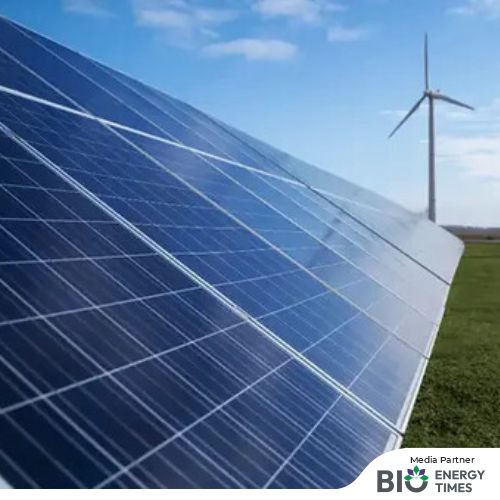
Karnataka has outlined plans to add 41.5 GW of wind and solar power capacity and around 11,000 MWh of battery energy storage by 2034-35, as the state steps up efforts to expand its renewable energy infrastructure and attract investments, Energetica India reported.
The state presented its renewable energy potential, investment opportunities and policy framework at the Bharat Renewable Energy Summit & Expo 2026, held at Bharat Mandapam in New Delhi, where it participated as a State Partner.

Gaurav Gupta, Additional Chief Secretary, Energy Department, Government of Karnataka, highlighted the state’s wind and solar resources, investor-friendly policies, automatic land conversion and plug-and-play infrastructure as key advantages for renewable energy investments.
He also highlighted the Pavagada Solar Park, which operates under a 30-year land lease arrangement with farmers.
Under its Resource Adequacy Plan, Karnataka aims to expand its clean energy infrastructure through large-scale renewable energy projects and energy storage systems. The proposed developments include a 250 MW solar project with 1,100 MWh of storage at Ryapte, standalone battery energy storage projects and a pipeline of renewable energy projects across Karnataka Power Transmission Corporation Limited (KPTCL) substations.
The state is also focusing on increasing farmer participation through the PM-KUSUM scheme and developing opportunities in green hydrogen, bioenergy, skill development and clean energy entrepreneurship.
Divya Prabhu GRJ, Managing Director of Karnataka Renewable Energy Development Limited (KREDL), said the state had an installed renewable energy capacity of around 27 GW, accounting for nearly 67% of its total installed power capacity.
She said KREDL was working to strengthen the renewable energy ecosystem through capacity building, technological advancement, incubation centres and industry-academia partnerships. Skill development initiatives such as Surya Mitra and Vayumitra are also part of these efforts, alongside collaborations with the University of New South Wales, IISc and IIM Bangalore.
Focus on wind repowering and investment opportunities
A plenary session titled ‘The Karnataka Advantage in Renewable Energy’ highlighted investment opportunities in renewable power generation, manufacturing, technological innovation, energy storage and industry-academia partnerships.
The discussions covered the state’s wind and solar resources, Pavagada’s land-lease model, transmission infrastructure, competitive tariffs and transparent project allocation mechanisms.
A separate panel discussion on wind turbine repowering examined opportunities to upgrade ageing turbines with advanced technologies, improve generation efficiency and maximise output from existing wind energy sites.
An industry roundtable brought together renewable energy developers, manufacturers and other stakeholders to discuss the state’s future renewable energy roadmap, policy support and measures to accelerate clean energy deployment and manufacturing.
Industry representatives were also invited to provide inputs for Karnataka’s forthcoming Renewable Energy Policy, as the existing policy is due to conclude in May 2027.
The Karnataka Pavilion, established by KREDL, showcased the state’s energy sector development and investment opportunities. Its design drew inspiration from Mysore Palace and Karnataka’s electricity heritage.
The state has a significant place in India’s power sector history, having established the Shivanasamudra Hydroelectric Power Project, one of Asia’s earliest hydroelectric power stations, and introduced India’s first electric street lighting in Bengaluru in 1905.
K J George, Karnataka Minister for Energy and Tourism, said the state’s participation in the summit reflected its commitment to promoting renewable energy investments and engaging with industry leaders and global stakeholders.