
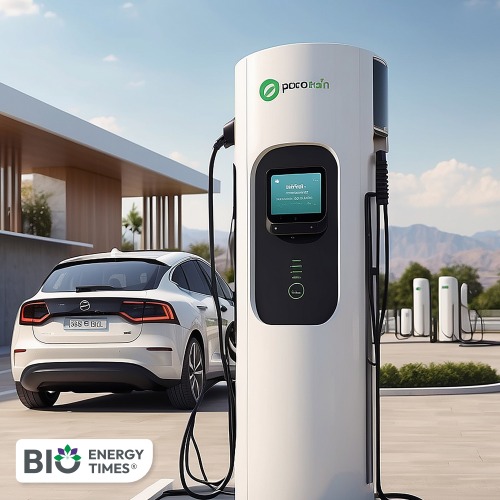
Nigeria has taken a step to advance clean transportation by signing a Memorandum of Understanding (MoU) with South Korea’s Asia Economic Development Committee (AEDC) to set up Africa’s first electric vehicle (EV) manufacturing plant and develop charging infrastructure across the country, Independent reported.
The agreement was signed on January 30, 2025, by Minister of State for Industry Senator John Enoh for the Federal Government, while AEDC Chairman Yoon Suk-hun signed on behalf of the South Korean body. The National Automotive Design and Development Council (NADDC) disclosed the development in a statement shared on its official X account.

According to the council, the partnership supports Nigeria’s National Energy Transition Plan and the National Automotive Industry Development Plan, both aimed at lowering carbon emissions, expanding local manufacturing, and improving industrial competitiveness.
The project will be carried out in stages, beginning with vehicle assembly before progressing to full-scale local production. Once operational, the facility is expected to produce about 300,000 vehicles annually and generate roughly 10,000 direct jobs, in addition to thousands of indirect roles across the automotive supply chain.
NADDC Director-General Oluwemimo Joseph Osanipin said the initiative would encourage technology transfer, attract investment, support workforce development, and boost research and innovation in the automotive sector. Represented at the signing by the council’s Head of Policy, Planning and Statistics, Nura Sidi, he added that Nigeria is steadily developing an automotive ecosystem focused on local production, cleaner energy use, and global competitiveness.
Interest in electric vehicles has been rising in Nigeria due to higher fuel prices, environmental concerns, and the global shift toward cleaner transport. However, questions remain about the practicality of widespread EV adoption, particularly given challenges such as unreliable electricity supply, limited charging networks, and poor road conditions in some areas.
Despite these concerns, the government has repeatedly indicated its commitment to electric mobility. In April 2021, the Nigerian Institute of Transport Technology established a 22-member team to develop a locally made electric vehicle. In August 2022, the National Agency for Science and Engineering Infrastructure signed an MoU with Israeli and Japanese partners to begin local EV assembly and manufacturing.
Nigeria’s Energy Transition Plan, introduced in 2022, targets a complete shift to electric vehicles by 2060 as part of the country’s broader net-zero ambitions. Lagos State has set an earlier goal, aiming for a full transition by 2050.
Several companies—including SAGLEV, Innoson Vehicle Manufacturing, Jet Motor Company, Spiro, NEV Motors, and the Electric Motor Vehicle Company—are already pursuing EV assembly or pilot projects across the country.
Global interest in the sector is also increasing. In May 2025, China announced plans to set up EV factories and other manufacturing ventures in Nigeria to deepen industrial cooperation. Analysts say large-scale EV production could help the country tap into its reserves of lithium and other battery minerals, promote local value addition, and reduce reliance on imported vehicles.
With the latest agreement with AEDC, Nigeria is positioning itself to become a significant player in Africa’s electric mobility sector while advancing industrial growth, employment, and climate goals.