
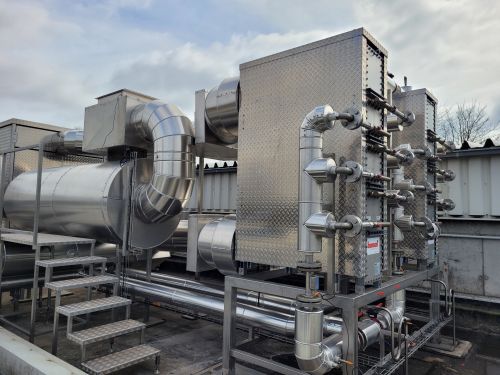
BOMAT Energiesysteme GmbH, a German specialist in corrosion-resistant heat recovery solutions, today announced the expansion of its product range for combined heat and power (CHP) plants, including for biogas and sewage gas fuels. The new models now cover outputs for smaller plants from 150 kW and larger plants up to 1,500 kW, giving operators a choice: recover surplus heat energy from exhaust gases or retrofit for fuel savings and emission reduction.
Made of pipes from high performance composites BOMAT heat exchange systems enable two efficiency strategies: heat recovery for monetizing surplus energy or fuel-saving retrofits for existing systems. In both cases operators on average 10 percent in thermal performance.

By capturing surplus heat, BOMAT systems not only boost the usable output of each CHP unit, but also contribute to reducing reliance on additional fuel sources while lowering overall emissions. For operators seeking to monetize excess heat, the expanded range offers a scalable and cost-effective solution, including offsetting heating costs or selling surplus energy to local heating networks.
“Our systems not only recover heat, but also help operators reduce their operating costs,” says Volker Wiersbitzki, sales engineer at BOMAT Energiesysteme GmbH. “Depending on the type of fuel, consumption can be reduced by up to 15 percent for gas and up to 10 percent for oil when using the fuel-saving retrofit option. This provides an attractive return on investment, typically within four years.” Additionally, the system reduces acid emissions by up to 60 percent and lowers CO2 output by up to 15 percent, supporting environmental compliance and sustainability goals.
In practice, operators can convert waste heat into value: In Germany, municipalities use this recovered heat to heat public swimming pools, food manufacturers such as bakeries use it for process water and space heating, while sewage treatment plants feed it back into their existing heating systems. Heat recovery offers additional advantages: operators can offset heating costs, and improve sustainability by reducing reliance on additional fuel sources.
Engineered for demanding conditions
Biogas and sewage gas-powered CHP plants produce highly corrosive exhaust gases at high temperatures – a challenge that BOMAT has met with a targeted selection of materials. BOMAT’s research engineers opted for a heat exchanger tube made of a high-performance composite material consisting of polyphenylene sulfide (PPS) and graphite (GR). Thanks to its unique combination of chemical resistance and thermal conductivity, this material enables BOMAT heat exchangers to operate reliably even below the acid and water dew point in environments where conventional stainless steel systems often fail.
Designed to handle exhaust temperatures up to 400°C when cooled, BOMAT exchangers also feature a dirt-repellent surface and a modular slide-in register system that simplifies cleaning and maintenance. Individual heating elements can be removed without dismantling the entire unit, minimizing downtime and ensuring long-term performance under continuous load.
How it works
The hot exhaust gases are passed through PPS-GR modules in the BOMAT heat exchanger, transferring the heat energy to a secondary medium such as water or a water-glycol mixture. The high thermal conductivity of the PPS-GR pipes ensures efficient heat transfer. As the exhaust gases cool, water vapor and acidic compounds condense, reducing air pollutants and allowing latent heat to be recovered. The modular design allows for easy cleaning and inspection and ensures consistent performance in demanding environments.
Making high-efficiency heat recovery more accessible
The expanded range makes high-efficiency heat recovery and fuel-saving retrofits accessible to a wider spectrum of CHP plants. The newly introduced models extend BOMAT’s range of applications to a wider range of CHP plants. Smaller plants, for which there were previously no suitable solutions for corrosive exhaust gas environments, can now benefit from the same robust technology used in larger systems. BOMAT systems are available from 16,500 Euros, depending on the configuration. The retrofit-friendly design also helps to minimize installation costs, making BOMAT a practical upgrade for small and large CHP plants.
BOMAT heat exchangers are designed for seamless integration into existing CHP plants and are usually installed as the last component in the exhaust gas system. The recovered heat is then fed into the existing heating system or used as process heat.
In addition to its core offering for CHP plants, BOMAT also supplies heat recovery solutions for industrial furnaces, including melting and hardening furnaces, where hot exhaust gases are often underutilized. Many of these systems are custom-designed for specific project requirements, reflecting BOMAT’s technical flexibility and in-depth application knowledge. The company also manufactures condensing heat exchangers and neutralization systems for OEM customers. BOMAT’s solutions are used in municipal infrastructures, industrial processes, and energy systems, where they reflect the performance and reliability associated with German engineering.
BOMAT will present its new model range at the Biogas Convention in Nuremberg, 9-11 December 2025.