

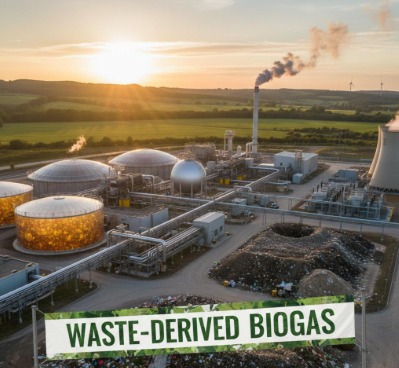
The waste derived biogas market size reached USD 35.7 billion globally in 2024, demonstrating robust momentum driven by increasing demand for renewable energy and sustainable waste management solutions, according to Growth Market Report.
The market is expected to grow at a CAGR of 7.8% from 2025 to 2033, reaching an estimated USD 70.6 billion by 2033. Key growth factors include stricter environmental regulations, rising energy needs, and government incentives that support biogas production as a clean energy alternative.

Introduction: From Disposal Problem to Energy Opportunity
India generates millions of tonnes of organic waste every year—from agricultural residues and food scraps to municipal solid waste and industrial effluents. Traditionally, this waste has been viewed as a disposal challenge. Today, it is increasingly seen as a strategic energy resource. The waste-derived biogas market is quietly transforming how India thinks about energy security, sanitation, rural income, and climate action—all at once.
Unlike conventional renewable energy narratives that focus on solar panels or wind turbines, biogas tells a more grounded story: energy created from what society throws away. This article explores how India’s waste-derived biogas market is evolving, why it matters uniquely to the Indian context, and how it could redefine decentralized energy in the coming decade.
Understanding Waste-Derived Biogas: Beyond Basic Digestion
Waste-derived biogas is produced through anaerobic digestion, a biological process where microorganisms break down organic matter in the absence of oxygen. The resulting gas—primarily methane and carbon dioxide—can be:
- – Used directly for cooking and heating
- – Converted into electricity and heat (CHP systems)
- – Upgraded into compressed biogas (CBG), chemically similar to natural gas
What sets waste-derived biogas apart in India is the diversity of feedstock. Unlike countries that rely mainly on landfill gas or livestock manure, India taps into a broader waste ecosystem—crop residues, sugarcane press mud, dairy waste, hotel and temple food waste, and sewage sludge.
Why India Is a Natural Fit for Biogas at Scale
1. Abundance of Organic Waste
India’s agrarian economy and dense urban centers generate year-round organic waste streams. Seasonal crop residues that are often burned—contributing to air pollution—can be redirected into biogas plants, converting an environmental liability into a clean energy asset.
2. Decentralized Energy Needs
Many rural and semi-urban regions still face unreliable grid power. Waste-derived biogas plants can operate at village, cluster, or city-ward levels, making them ideal for distributed energy models rather than centralized infrastructure.
3. Circular Economy Alignment
Biogas production does not end with gas alone. The leftover digestate becomes nutrient-rich organic fertilizer, closing the loop between energy, agriculture, and soil health—an essential consideration for India’s long-term food security.
Policy as a Market Catalyst
India’s waste-derived biogas market is not growing by chance; it is being intentionally shaped by policy.
One of the most influential drivers is the SATAT Initiative (Sustainable Alternative Towards Affordable Transportation) program. SATAT encourages entrepreneurs to set up compressed biogas plants and guarantees offtake through oil marketing companies.
Complementing this is support from the Ministry of Petroleum and Natural Gas, which positions CBG as a strategic substitute for imported natural gas and conventional fuels.
Together, these policies are transforming biogas from a niche sustainability project into a commercial energy market.
Market Structure: Who Is Building India’s Biogas Future?
Public Sector Anchors
Large public enterprises such as GAIL and Indian Oil Corporation play a critical role by integrating biogas into existing gas distribution and fuel retail networks. Their involvement reduces market risk and accelerates investor confidence.
Private Entrepreneurs and Startups
A new generation of Indian startups is designing modular biogas plants, smart monitoring systems, and feedstock aggregation models. These players are not just technology providers—they are creating localized business ecosystems around waste collection, plant operation, and fertilizer sales.
Municipal and Industrial Partnerships
Urban local bodies and industries with high organic waste output—food processing units, dairies, distilleries—are entering long-term supply agreements with biogas operators, ensuring steady feedstock availability.
Technology Evolution: From Simple Digesters to Smart Plants
Early biogas plants in India were often low-tech and maintenance-heavy. The modern waste-derived biogas market looks very different:
- Automated feedstock handling reduces labor dependency
- IoT-based monitoring improves gas yield predictability
- Advanced gas upgrading systems enable pipeline-grade CBG
- Odor and effluent management technologies address community concerns
This technological shift is critical for scalability, especially in urban India where space constraints and public acceptance matter.
Economics That Go Beyond Energy
The true strength of the waste-derived biogas market lies in its multi-layered value creation:
- Energy revenue from gas sales
- Fertilizer income from digestate
- Waste processing fees from municipalities and industries
- Carbon credits linked to methane capture and fossil fuel substitution
For India, this blended revenue model is particularly powerful because it aligns environmental goals with livelihood generation—especially for rural youth and small entrepreneurs.
Challenges That Still Need Solving
Despite strong momentum, the market faces structural hurdles:
- Inconsistent feedstock quality and supply logistics
- Financing challenges for first-time plant developers
- Limited technical skill availability at the local level
- Need for clearer long-term pricing visibility for CBG
Addressing these issues will determine whether the market grows steadily or accelerates exponentially.
Competitive Landscape
- – Air Liquide
- – Air Products and Chemicals, Inc.
- – Ameresco, Inc.
- – Archaea Energy
- – Atlas Copco AB
- – Bioenergy DevCo
- – Bright Biomethane
- – Clarke Energy
- – DMT Environmental Technology
- – ENGIE SA
- – EnviTec Biogas AG
- – Hitachi Zosen Inova AG
- – Linde plc
- – MT-Energie GmbH
- – Nature Energy
- – Nordsol
- – PlanET Biogas Group GmbH
- – Renewi plc
- – SUEZ Group
- – Veolia Environnement S.A.
Future Outlook: Biogas as an Indian Energy Identity
Waste-derived biogas is not just another renewable option for India—it reflects an Indian solution to Indian problems. It speaks to waste overload, energy imports, farmer distress, and climate commitments in one integrated framework.
Over the next decade, the market is likely to shift from isolated projects to regional biogas clusters, connected to city gas distribution networks and rural microgrids alike. As this happens, waste will no longer be seen as an endpoint, but as the first step in a value chain that powers homes, fuels vehicles, enriches soils, and strengthens local economies.