
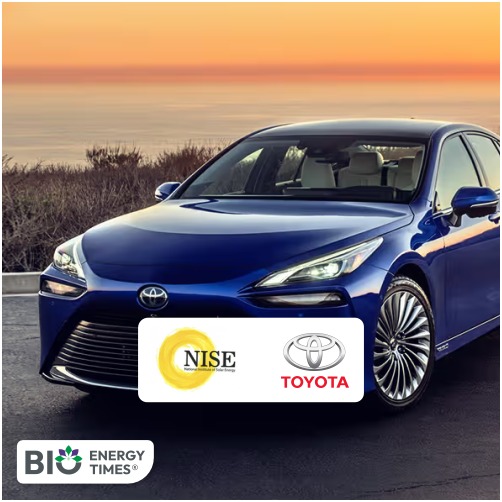
The National Institute of Solar Energy (NISE) and Toyota Kirloskar Motor (TKM) have signed a memorandum of understanding (MoU) to accelerate the development of green hydrogen mobility in India, reports Energetica India.
The partnership will support India’s National Green Hydrogen Mission by enabling real-world testing of Fuel-Cell Electric Vehicles (FCEVs) under a wide range of Indian conditions, including climate, traffic patterns, driving behaviour and fuel quality.

The MoU was exchanged between Dr. Mohammad Rihan, Director General of NISE, and Vikram Gulati, Country Head and Executive Vice President for Corporate Affairs and Governance at TKM, in the presence of Union Minister for New and Renewable Energy Pralhad Joshi and Minister of State for New and Renewable Energy Shripad Yesso Naik.
Joshi said green hydrogen is emerging as a key element of the world’s future energy systems. He noted that the collaboration, along with the handover of Toyota’s Mirai hydrogen fuel-cell electric vehicle to NISE for on-road testing, brings together innovation, technical expertise and scientific rigour to support India’s clean energy transition.
Under the MoU, NISE will conduct a detailed assessment of the Mirai across India’s varied road and climate conditions, including heat, dust, heavy traffic and changing terrain. The minister said the two-year testing period will provide essential insights for expanding hydrogen mobility nationwide while building awareness and technical capability among industry, academia and policymakers. He highlighted that hydrogen fuel-cell vehicles are clean, quiet and emission-free, releasing only water, and noted that fuel-cell technology is increasingly used in transport and stationary power systems worldwide.
Joshi said that by personally driving the hydrogen vehicle, he wants to send a clear message that hydrogen mobility is suitable for Indian conditions. He praised TKM for its commitment to carbon neutrality and commended NISE for supporting India’s clean energy goals. He added that the initiative represents not just an MoU but a commitment to a sustainable future.
Minister of State Naik said the initiative is an important step toward a clean and self-reliant energy future. He said that real-world testing of FCEV technology such as the Toyota Mirai shows India’s fast progress from policy to experimentation and eventually to commercial deployment of hydrogen-based mobility solutions. He added that the testing will generate useful data for future expansion and expressed confidence that the project will support wider adoption of hydrogen-powered transport, improved air quality and sustainable development.
Vikram Gulati of TKM said the partnership and the handover of the Mirai for testing reflect the company’s commitment to supporting India’s Green Hydrogen Mission and advancing mobility based on clean, domestic energy sources. He said hydrogen fuel-cell technology, along with other sustainable solutions, will play an important role in helping India achieve its net-zero goals and energy independence.
The collaboration aims to advance the use of green hydrogen in transport, set new standards in environmental leadership and contribute meaningfully to India’s renewable energy and decarbonisation goals.