
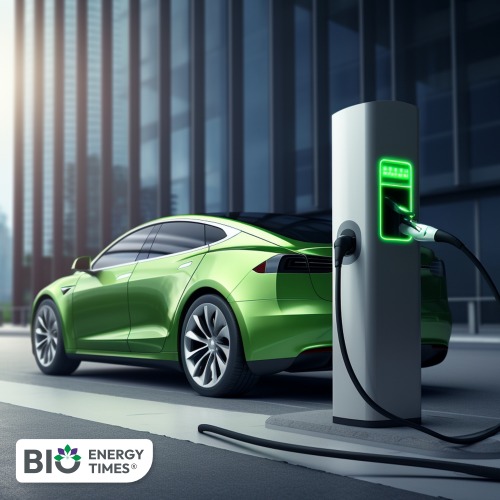
Once upon a time, when the country witnessed the entry of electric vehicles, nature breathed “restoration”. Fast forward to today, rolling out more electric vehicles has emerged to be a lesser challenge than dealing with its blind spot – the one that resides within the battery.
Beneath the lens of quality infrastructure, innovation and compliance, lies an indispensable yet sparse foundation – Rare Earth Minerals. A part of the larger group, Lithium, neodymium, dysprosium and praseodymium fuel the sustainable electric vehicle revolution. Worth its weight in gold, these resources are essential to the manufacture of advanced electronics and cutting-edge batteries.

Prized for their ability to establish an excellence benchmark delivering high torque and efficiency, these minerals sit tight in the compact yet brilliantly-engineered magnet motors. They narrate the impact everywhere – from the buzz of an electric motor to the promise of a sustainable, resurrected and self-reliant future.
Who’s the Winner – It’s the Global Stage
Control over these minerals fosters leadership at the global pavilion, thereby catapulting supply chain leader nations up the international ladder. A secure route to these minerals promotes the country to a better rank to dominate an emerging myriad of sectors, inter alia, electric mobility, manufacturing and renewable energy. Without these minerals, accelerating EV manufacturing poses a challenge to its cost-efficiency, thereby emerging as a key determinant for India’s laurels in the EV mobility industry.
The long-term economic trajectory of India stands heavily dependent on the Rare Earth Elements, the unavailability of which can pose constraints on expansion routes, job creation and employability, leading to a failure in achieving the phenomenal goals of “Viksit Bharat”. Rapidly becoming the “oil” of the 21st century, these minerals are fiercely coming to light, engulfing the entire modern economy under their support.
Colonialism or Self-Sufficiency?
Currently, the vision of Viksit Bharat does not synergise with its ambition of Aatmanirbharta, with India importing 80- 90% of its magnets and other requisites from China, controlling more than 90% of global rare earth processing. Despite possessing the world’s third – largest rare earth reserves with a 8% concentration along the shores and sands of Kerala, Andhra Pradesh, Gujarat, Maharashtra, Tamil Nadu and Odisha, the statistics account for less than 1% of global mining. It is not a moment of fortune to witness the only operational mine residing in Andhra Pradesh – exporting its output to Japan until June 2025.
Presently, India stands on the shoulder of China for importing rare earth minerals. Imagine trade barriers, restrictions or even a complete cessation of operations leading to a quiet halt in the Indian EV industry mobility. A silent pause – yet the one that speaks loud of the nation’s fading economic shelter. As per official figures, in 2025, India imported magnets and related raw material worth $221m, posing significant challenges to self-reliance and autarky in today’s epoch of tormenting competition. As EV adoption increases, there’s a visible intensification of competition wandering around the EV industry and its strategic production.
Bharat – Rising through Aatmanirbharta
With the solicitudes of cutting down dependance, emerging as robust players and living the dream of self-reliance, India has begun to ameliorate the situation and remodel its approach to critical minerals.
Combustion to Ambition, not an illusion
For – for India, Aatmanirbharta is not mere delusion.
“We will do it”, uttered a whisperer
This is what Bharat is – Aatmanirbhar!
In the nation’s advancement towards self-sustenance, the government has approved a ₹7,280 crore scheme to develop 6,000 MTPA of integrated REPM manufacturing capacity in November 2025, encompassing the complete value chain from rare-earth oxides, intermediate processing to finished magnets.
Bolstering the efforts in this direction, the Union Budget 2026-27 has underscored the creation of Dedicated Rare Earth Corridors in Odisha, Kerala, Andhra Pradesh, and Tamil Nadu to stimulate mining, processing, research, and manufacturing. In a recent milestone, the Union Cabinet approved a ₹1,500 crore Incentive Scheme under the National Critical Mineral Mission (NCMM) for upscaling India’s recycling capacity for critical minerals. The programme seeks to create an annual recycling capacity of 270 kilo ton, produce 40 kilo tons of critical minerals, inviting ₹8,000 Crore in investments and generating 70,000 jobs on the horizon. Under the NCMM, Geological Survey of India (GSI) has been assigned to carry out 1,200 exploration projects from FY25 to FY31, thereby fortifying supply chain resilience and lessening vulnerability to imports.
Beyond What’s Visible
The story of India’s EV mobility can no longer be viewed solely through the lens of charging stations and incentives that lure customers, but rather as a greater paradigm that shapes the future of a self-reliant morning in India. As we march forward, we aim to
Shoulder to Lean
The myriad showcases a profound transformation – a deeper reflection, that extends its reach to acquiring critical minerals, creating emphasis on domestic manufacturing, securing energy and creating scope for a sustainable nation that lends a shoulder and needs none to lean on.