
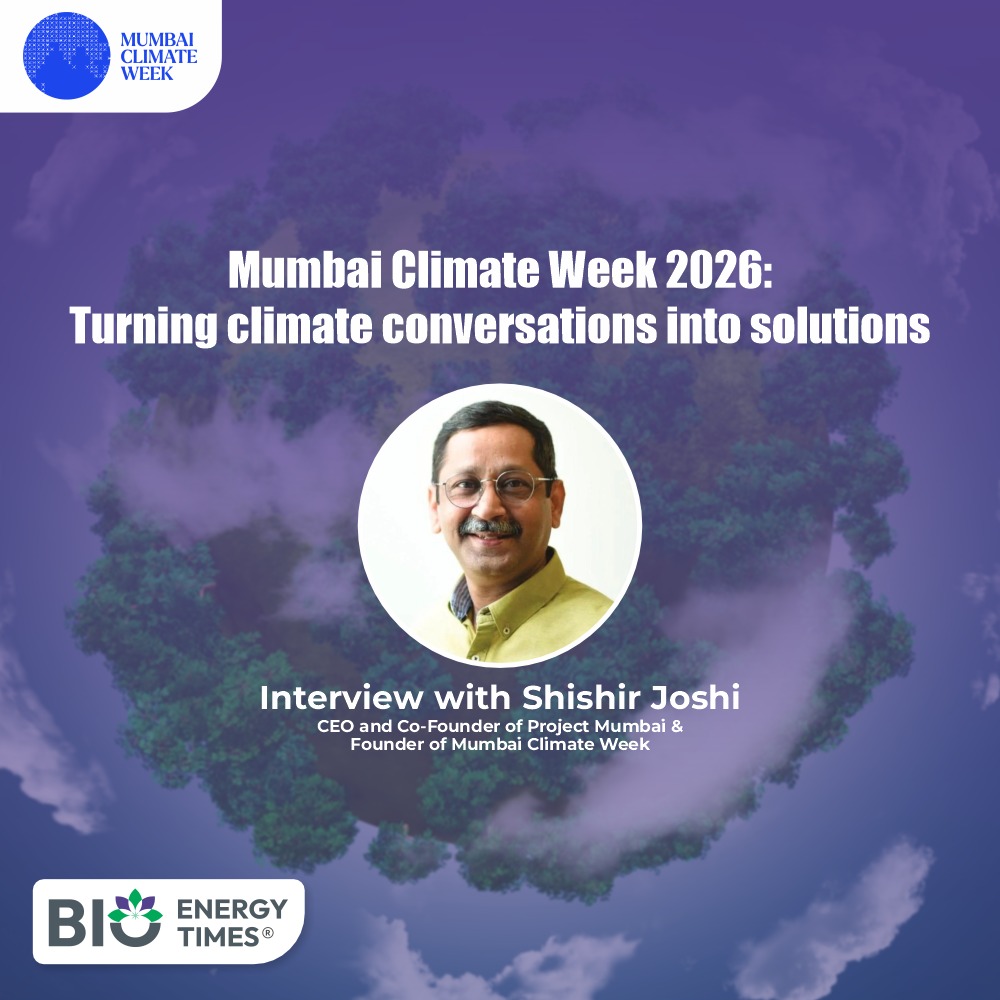
Mumbai is set to host Mumbai Climate Week 2026 from February 17 to 19, bringing together global stakeholders to discuss solutions for climate challenges. Organised by Shishir Joshi, CEO and Co-Founder of Project Mumbai and Founder of Mumbai Climate Week, the event aims to promote collaborative action toward a sustainable future. In a conversation with Bioenergy Times’ editor Prakash Jha on the sidelines of the event, Joshi shared his views on the objectives of the summit, citizen-led climate action, and Mumbai’s potential to serve as a model for resilience.
Q. India has hosted several climate conferences in the past. What, in your view, has been missing from these efforts that Mumbai Climate Week (MCW), bringing together delegates from over 30 countries to shape a just climate future for the Global South, intends to address?

Climate conversations in India have largely happened in silos—policymakers in one room, businesses in another, communities in a third. MCW is designed differently. MCW brings all these voices together on a single platform, creating the conditions for solutions to find pathways to scale.
It operates on a Public-Private-People Partnership model, bringing the state, market actors, and citizens into the same room with equal voice. The three-day summit at Jio World Convention Centre (February 17-19, 2026) is structured around three themes—Urban Resilience, Food Systems, and Energy Transition—with parallel tracks that include not just plenaries with ministers and CEOs, but also Innovation Challenge jury rounds, investor ‘speed-seeding’ sessions, youth showcases, and community-driven conversations on climate through art, food, cinema, and culture.
What’s been missing is a platform that treats climate action as a systems challenge requiring coordination across sectors, not sequential action by isolated players—and one that’s outcome-oriented, designed to turn conversations into funded projects, partnerships, and measurable impact. MCW positions Mumbai—and by extension, the Global South—not as a recipient of climate solutions, but as a laboratory where they are co-created.
Q. “Citizen-led climate action” is a powerful phrase, but what does it translate to in practice? How much influence will ordinary citizens actually have on decisions or outcomes at MCW?
When we say “citizen-led,” we don’t just mean checking a box. At MCW, citizens are doing the work rather than just watching from the sidelines, and this is especially true for the youth. We have teamed up with UNICEF India’s YuWaah to launch a Campus Roadshow across several colleges and a Youth Green Innovation Challenge. This invites young people between 16 and 24 to build and show off their climate solutions.
We plan to shortlist a few of these young innovators, put them through a mentorship bootcamp, and give them a spot on the main stage right next to policymakers and investors. But it goes beyond just students. We are bringing in community voices through art installations and street-level conversations about healthy air. We also have sessions where street vendors, traffic wardens, and residents of informal settlements can speak openly about their daily reality with urban heat. By using cinema, food festivals, and art, we are turning climate change from a distant threat into a conversation about everyday choices.
Q. How do you plan to bridge the gap between high-level discussions and local communities who often bear the brunt of climate impacts?
We bridge the gap through intentional design, not just goodwill. First, MCW deliberately extends well beyond the three-day summit at the Jio World Convention Centre. From February 4 to 17, our Campus Roadshow takes climate conversations directly to students through e-waste mural exhibitions, panel discussions on green careers, and interactive installations where students can contribute their own climate stories.
Second, we anchor the programming at the main event in actual community experience. For instance, the Healthy Air Zones panel brings street vendors, roadside residents, and traffic wardens to discuss air quality right alongside city commissioners and policymakers.
Third, MCW uses softer entry points like cinema, food, sport, and art to make climate issues accessible in everyday language instead of technical jargon. We know that a film screening on urban flooding reaches people in ways a policy brief never will.
Fourth, the Innovation Challenge and Solutions Showcase prioritize community-led innovations and grassroots models rather than just venture-backed startups. The goal is to ensure that when decisions are made in the plenary, the people actually living those realities have already helped shape the framing.
Q. In what ways do you believe Mumbai can realistically serve as a resilience model for other emerging economies?
Mumbai shares the same density, infrastructure challenges, and climate vulnerabilities as cities like Dhaka, Lagos, Jakarta, and Manila. MCW positions Mumbai not as a city that has solved these challenges, but as a laboratory. It is a place where diverse stakeholders including the government, private sector, and communities are actively testing collaborative approaches. Together, they are working on solutions for Urban Resilience, Food Systems, and Energy Transition.
This positions India not just as a participant in global climate discussions, but as an emerging leader shaping solutions for the Global South and the wider region. Importantly, MCW’s learnings have domestic relevance too—cities like Ahmedabad, Pune, Surat, Chennai, and Bengaluru share similar density and infrastructure challenges, and can adapt MCW’s collaborative frameworks, financing models, and community engagement strategies to their own contexts
Q. How does the partnership with NSE for the Climate Innovation Challenge aim to identify and support startups working on adaptation, climate finance, and community resilience, and what outcomes do you expect from this collaboration?
Our partnership with NSE brings essential institutional rigor and investor infrastructure to climate innovation. The MCW Innovation Challenge adheres to a strict six-stage evaluation process. It begins with an initial screening, followed by virtual pitches, then move on to in-person jury presentations across multiple cities. From there, the top pitches enter a mentorship bootcamp leading up to the Finalist showcase at MCW 2026 from February 17 to 19. The journey concludes with post-event investor speed-seeding sessions.
This challenge is open to startups, social enterprises, research institutions, and community-led innovators from India and the Global South. We are looking for solutions specifically in Food Systems, Urban Resilience, and Energy Transition. NSE plays a critical role here by connecting shortlisted innovators to capital markets. They provide access to dedicated investor forums, platform visibility, and their wider ecosystem of financial institutions and climate-focused funds.
The expected outcome is not just about winning awards. It is about creating tangible pathways to capital that turn pilot-stage solutions into investment-ready propositions. This runs parallel to the Youth Green Innovation Challenge for ages 16 to 24, which creates a full spectrum of support ranging from early-stage student ideas to growth-ready enterprises.
Q. Among the three core themes – food systems, energy transition, and urban resilience – which area presents the most significant implementation challenges in Mumbai today?
These three themes have been chosen precisely because they are tightly interconnected, and trying to single out one as the most challenging would be misleading. Food systems rely on clean, reliable energy and resilient urban infrastructure for production, storage and distribution. Energy transition depends on how the city is planned and built. Urban resilience in turn is impossible without secure food systems and accessible, low carbon energy for all communities.
In a city like Mumbai, which is representative of many fast growing, climate vulnerable megacities, the real implementation challenge lies in managing these linkages rather than treating food, energy and resilience in isolation. Progress in one area unlocks progress in the others. Clean energy makes cold chains viable and reduces pollution. Better urban planning cuts energy demand and strengthens protection from floods and heat. Circular approaches to food and waste can generate local renewable energy. Mumbai Climate Week therefore approaches these themes as one integrated agenda, not a set of competing priorities.