

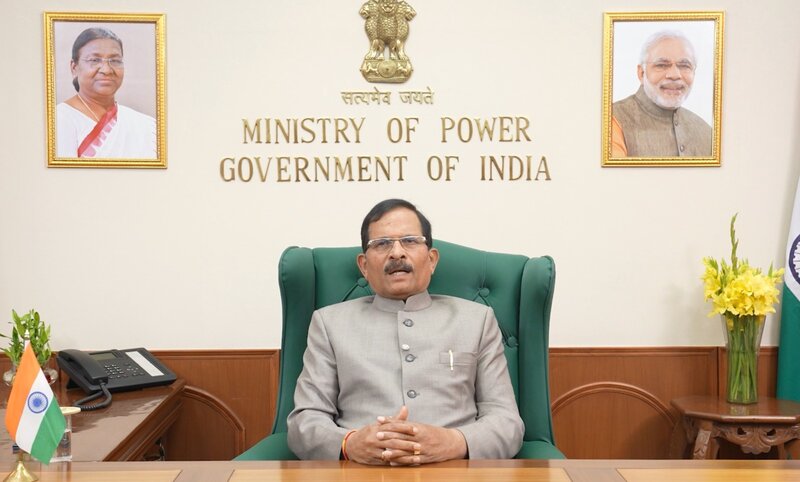
NEW DELHI: India’s energy transition is not just an aspiration but an ongoing transformation, anchored in clear targets and backed by decisive decisions, said Shripad Yesso Naik, Minister of State for Power and New & Renewable Energy.
“Under Prime Minister Narendra Modi’s vision, India has set an ambitious goal of achieving 500 GW of non-fossil fuel capacity by 2030 and is progressing towards Net Zero by 2070,” he added.

Addressing the two-day ‘India Energy Transition Summit’, organised by FICCI, Naik said that the country’s total installed power capacity has crossed 520 GW, with more than half coming from non-fossil sources. Solar capacity has more than tripled in recent years, and renewable energy is now mainstream rather than marginal.
“This progress reflects policy clarity, transparent competitive bidding, expansion of green energy corridors, promotion of ultra-mega renewable energy parks, rooftop solar under the PM Surya Ghar Yojana, agricultural solarisation through the PM KUSUM Yojana, along with a strong push for domestic manufacturing,” he noted.
The Minister further stated that through the National Green Hydrogen Mission, the government is creating the next growth frontier by enabling industrial decarbonisation, reducing import dependence, and strengthening India’s position in emerging global value chains.
“Sustaining this momentum requires moving beyond capacity addition to system integration. We must strengthen the transmission network, scale up storage solutions, improve grid flexibility, and ensure the financial sustainability of distribution companies. Energy security, affordability, and inclusivity must remain at the core of our approach,” Naik highlighted.
He added that industrial decarbonisation will be central to the next phase of the transition. Hard-to-abate sectors such as steel, cement, chemicals, and refining must adopt clean technologies, green hydrogen, electrification, and innovative financing models.
“Collaboration between government, industry, financial institutions, and global partners will determine the speed and success of this transformation,” the Minister emphasised.
He said India’s energy transition is not only about reducing emissions, but also about enhancing competitiveness, generating employment, strengthening energy independence, and building a resilient economy.
“It is also about ensuring clean energy-powered growth across villages, cities, MSMEs, and industry. Together, let us sustain the momentum and make India’s energy transition a model for the world — strong in ambition, steady in execution, and inclusive in impact,” Naik asserted.
Ghanshyam Prasad, Chairperson, Central Electricity Authority, Government of India, said the country’s energy transition is now backed by structured, long-term system planning. With a comprehensive roadmap prepared under NITI Aayog in coordination with the Central Electricity Authority, India has moved from ambition to an actionable strategy, focusing on resource adequacy, electrification, storage, and transmission planning up to 2070.
He further stated that the next phase of the transition will require balancing renewable expansion with grid stability, market reforms, and financial sustainability. Emphasis on pumped hydro, battery storage, nuclear capacity expansion, carbon markets, and policy reforms signals a shift from capacity addition to system resilience and reliability, he added.
Prasad said that India’s energy transition is not confined to one segment; it requires coordinated action from government, regulators, developers, financial institutions, and consumers.
“Only through collective effort can we build a secure, affordable, and sustainable energy future,” he said.
Gisela Kristoferitsc, Deputy Head of Mission, Embassy of Austria in India, said, “I am truly impressed not only by the ambitious targets India has set for itself, but even more by the remarkable progress already achieved. Coming from Austria, where nearly 90% of electricity is renewable, I deeply admire the scale, speed, and inclusiveness of India’s energy transition, which is driving economic growth while strengthening resilience and global cooperation.”
Pinaki Bhattacharyya, Co-Chair, FICCI RE CEOs Committee and Founder, Managing Director & CEO, AMPIN Energy Transition, said, “India is today one of the largest and fastest-growing renewable energy markets in the world. The energy transition is like a four-wheel journey — policy support, finance, developers, and consumers must move in perfect alignment. When these four forces work together, we can accelerate toward our 2030 milestones and the long-term vision of net zero by 2070.”
Dinesh Batra, Co-Chair, FICCI Power Committee and Executive Vice President, Hindustan Power Projects, said that as India moves toward its 2070 net-zero vision, success will depend on how well it balances green growth with energy security, affordability, and system reliability.
Sandy Khera, Chair, FICCI RE Developers Taskforce and Country Manager & CEO, Enel Green Power, said the transition is no longer a distant vision but central to India’s economic future. With stability, flexibility, and disciplined execution, India can lead the global energy transition through scale, innovation, and inclusive growth, he noted.
Prabir Neogi, Mentor, FICCI Power Committee, said, “Achieving our clean energy goals will require strong policy alignment, grid and storage readiness, financial innovation, and disciplined execution. If we remain guided by reliability, affordability, sustainability, and inclusiveness, India is well-positioned to lead the global transition with scale and conviction.”