

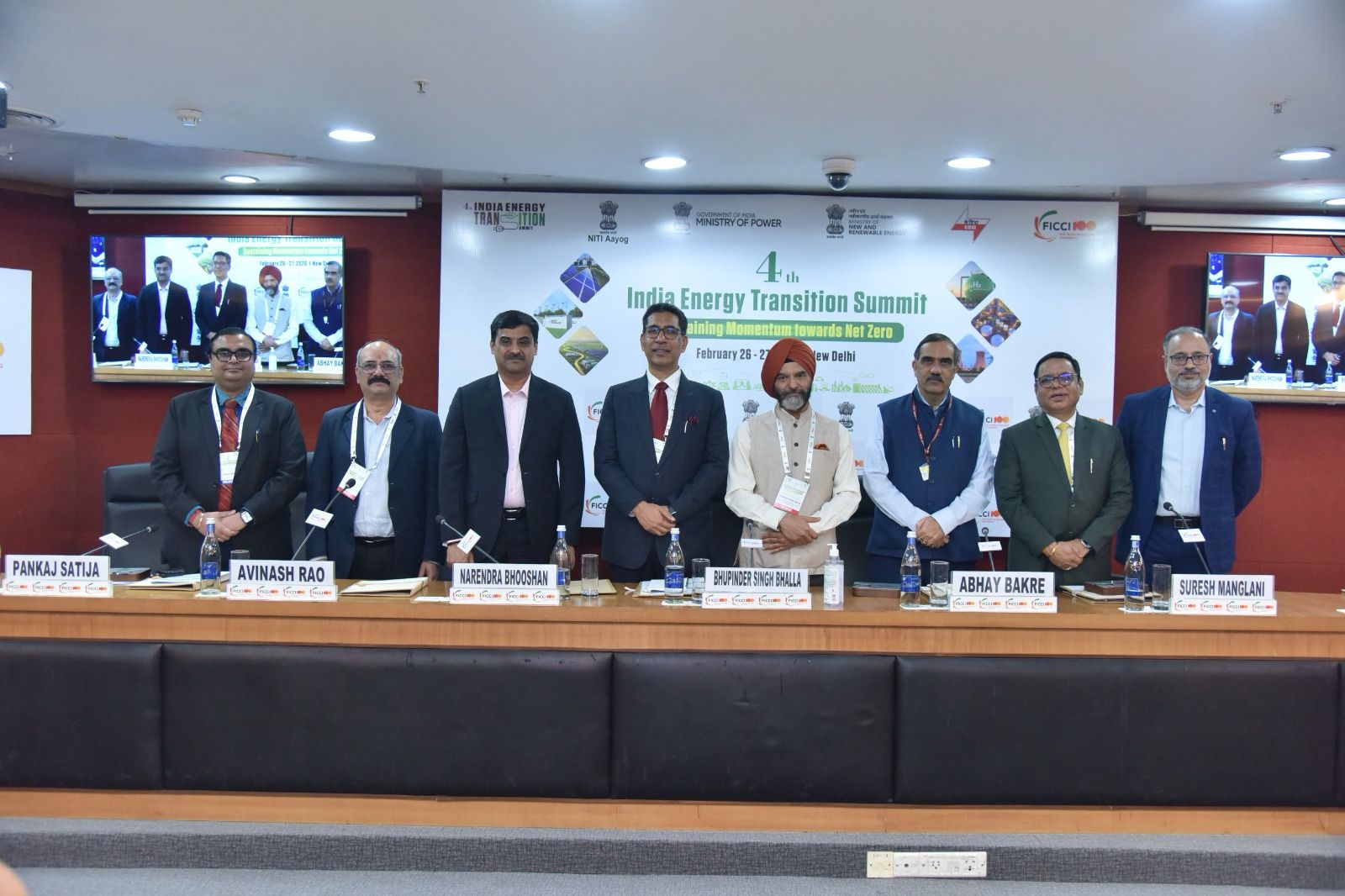
NEW DELHI: Bhupinder Singh Bhalla, Former Secretary, Ministry of New & Renewable Energy, Government of India, while addressing the ‘FICCI India Energy Summit’, said that India’s energy transition is now entering a definitive phase and moving from execution to integration, having progressed from intent to implementation.
He added that the focus must be on aligning policy frameworks, strengthening coordination between the Centre and state governments, and deepening international partnerships to accelerate technology deployment and investment flows. “With cohesive policy direction, collaborative governance, and global engagement, India can scale its transition in a structured and confident manner while sustaining economic growth,” he said.

Bhalla further stated that green hydrogen will be a cornerstone of decarbonisation, particularly for hard-to-abate sectors where direct electrification is not feasible. “Decarbonisation must therefore move from being policy-driven to market-driven, and that is where carbon markets become critical. While it may not be the sole solution, it is set to play a significant role in transforming industries such as steel, refining, fertilisers, and heavy transport. To unlock its full potential, demand aggregation, pilot deployments, and targeted viability gap support will be essential in the early stages. As scale improves and costs decline, green hydrogen can become a transformative force in India’s low-carbon industrial transition,” he emphasised.
Bhalla stated that India’s decarbonisation journey cannot rely on renewables alone and that expanding clean electricity, while essential, addresses only a fraction of total energy consumption. The real challenge lies in transforming hard-to-abate sectors such as steel, cement, chemicals, transport, and MSMEs.
“This transition demands not only new technologies like green hydrogen and carbon capture, but also strong economic signals that make low-carbon choices commercially viable. Decarbonisation must therefore move from being policy-driven to market-driven, and that is where carbon markets become critical,” he noted.
Bhalla highlighted that a well-designed carbon market can become the backbone of India’s transition strategy. Carbon markets help bridge the massive financing gap required for net zero by mobilising private investment at scale.
“If implemented effectively, India’s emerging carbon trading framework can transform climate ambition into measurable economic action, making decarbonisation not just an environmental necessity but a competitive advantage,” he added.
Abhay Bakre, Mission Director, National Green Hydrogen Mission, Ministry of New & Renewable Energy, Government of India, said, “Energy is the backbone of GDP, but growth depends not just on more supply; it rests on three pillars — efficiency, renewables, and smart fuel switching. For India, the goal is to provide each sector with the right energy, not simply reduce consumption. Today, the key barrier is the disconnect between energy supply and GDP creation, and closing this gap is essential to ensure the transition strengthens economic growth.”
He also highlighted that the source of renewable energy consumed by any sector should be optimal, depending on its requirements, economic feasibility, available infrastructure, and national priorities.
Narendra Bhooshan, Additional Chief Secretary, UPNEDA, Government of Uttar Pradesh, said that the energy transition will not accelerate unless states move faster in implementing policies announced by the Centre, adding that Uttar Pradesh is committed to turning ambition into large-scale, practical implementation.
Inviting industry to invest in the state, Mr Bhooshan said, “Biogas is not just a waste management solution; it is a rural economic opportunity and a clean energy pathway that also supports farmer income and addresses stubble management. With stable policy, faster clearances, assured offtake, and long-term price certainty, Uttar Pradesh can convert agricultural residue into reliable green fuel at scale and move bioenergy from the pilot stage to a mainstream pillar of its energy transition.”
Avinash Rao, Co-Chair, FICCI RE CEOs Committee and Managing Director & CEO, Mahindra Susten, said, “India’s energy demand is set to rise rapidly as our economy grows, but achieving net zero will require more than adding renewable capacity. It demands urgent action on grid congestion, faster transmission expansion, timely closure of pending power purchase agreements, and large-scale deployment of storage.”
Suresh Manglani, Co-Chair, FICCI Hydrocarbons Committee and CEO, Adani Total Gas Ltd, said, “India’s journey to net zero will be defined not by one fuel replacing another, but by structured energy coexistence, where renewables, natural gas, biofuels, and emerging technologies grow together to power economic expansion. Cleaner fuel adoption should strengthen competitiveness, protect jobs, and accelerate industrial growth, proving that sustainability and economic development can advance together.”
Vijay Kumar Srivastava, COO & Whole Time Director, Jubilant Ingrevia Ltd, said that as a G20 nation, India is not only participating in the global climate conversation but also helping shape it.
Dr Pankaj Satija, Co-Chair, FICCI Mining Committee and Executive Vice President, JSW Group, said that the energy transition is inevitable and must be time-bound. He added that it will require coexistence between conventional and renewable sources, and real progress depends on advancing electrification, energy efficiency, and renewable expansion together.