
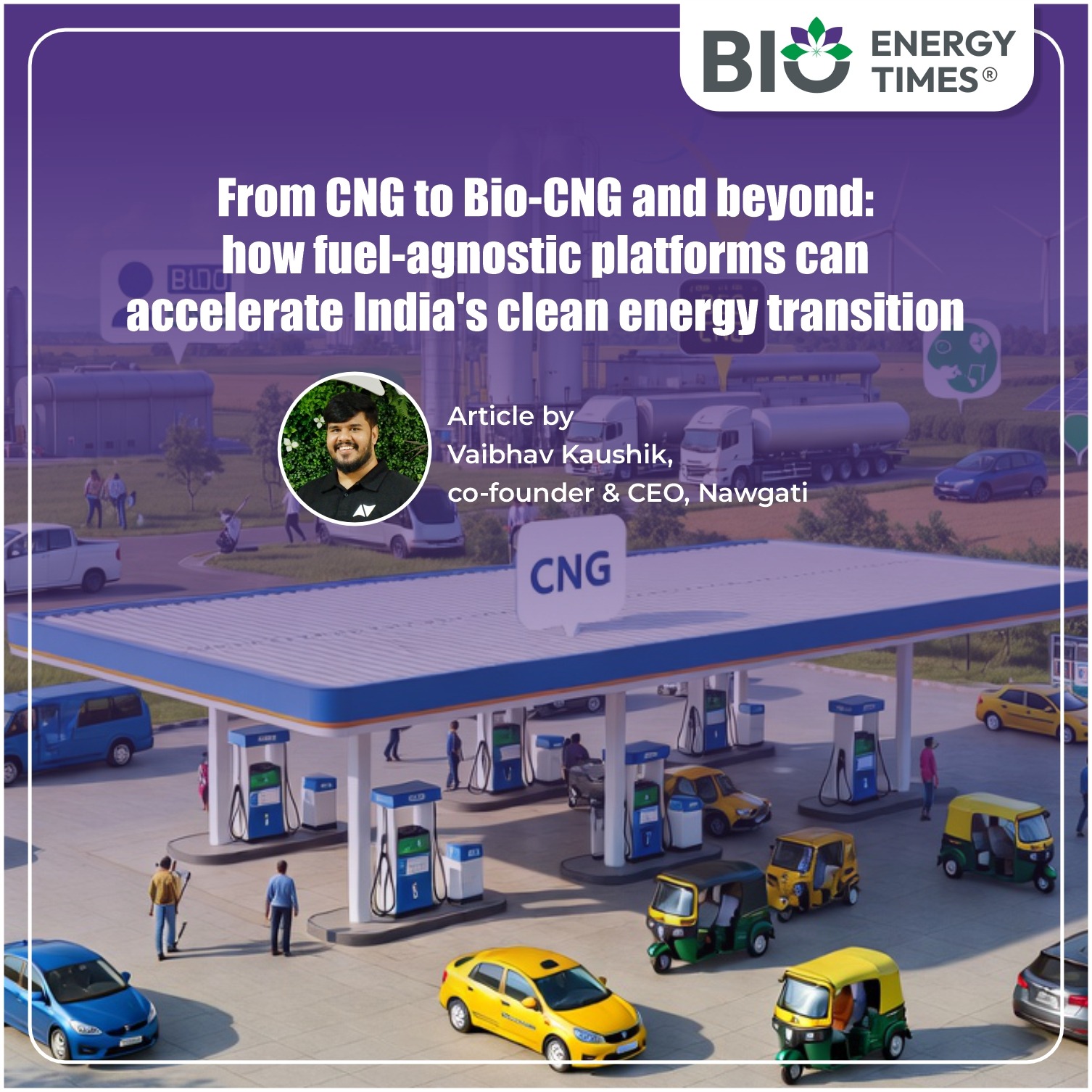
Over a decade ago, CNG was a greener fuel in Tier 1 cities like Delhi and Mumbai, but it’s no longer the same. Today, almost all sorts of fuels are available, even in remote areas, as India isn’t aiming for a single ‘fuel of the future.’ It is entering the most diverse and complex energy era the mobility sector has ever experienced.
The reality on the ground is far more complicated and engaging. There are numerous fuel options to choose from: petrol, diesel, CNG, LPG, and electric, and for at least the next two decades, India will operate in a mixed-fuel environment where CNG, bio-CNG, ethanol blends, LNG, EVs, hydrogen, and other alternatives will coexist. The true challenge will not be to encourage adoption, but to ensure that all these types of fuels are readily available and that real-time information is readily accessible.

That is where fuel-agnostic thinking will become essential.
We are living in a multi-fuel reality.
If you look around today, India’s fuel landscape is diversifying at the speed of light. On one hand, ethanol blends are quietly becoming the new normal, and on the other, EV chargers are being installed on highways. Oil and gas companies are setting up LNG stations along major freight routes, and hydrogen buses are running early pilots in select cities. This isn’t just a transition; it’s happening all at once. And that’s exactly why no single fuel will ‘win.’
A taxi operator in Delhi might choose CNG because of predictable operating costs, while a long-haul fleet in Gujarat may shift to LNG for better range. A family in Pune might consider an EV because of city-friendly charging, while a farmer in Madhya Pradesh may stick to diesel for local availability. People will choose what works for their routes, their pockets, and their realities. But with a growing population and increasing vehicle sales across all fuel types nationwide, we’re seeing an uneven distribution of energy and fuel stations, and limited access to certain fuel types, which could discourage and potentially slow down the energy transition.
But, fuel-agnostic platforms could help accelerate India’s clean energy transition.
Fuel-agnostic digital platforms will serve as a bridge across this fragmented ecosystem. Startups designing these platforms are leveraging on-ground data to avoid favouring one fuel over another and to establish a common operational layer that enables multiple fuels to coexist efficiently.
In reality, such platforms can provide real-time availability and congestion data across fuel types, facilitate dynamic routing decisions for fleets based on fuel access, not just distance, maximise station utilisation and minimise idle emissions caused by waiting and detours, and generate demand signals aiding policymakers and suppliers in planning infrastructure.
Such information will encourage end users to transition to cleaner fuels with better knowledge of what they are getting into, as vehicle purchase is a huge investment in a country like India.
Building a smarter infrastructure.
India’s energy shift will be powered not solely by fuels but by intelligent and connected infrastructure embedded within it. Some of the key areas where startups will need to focus to create a fuel-agnostic platform are:
- A consumer-facing platform: An app or a platform that displays availability, wait times, pricing signals, and nearby alternatives empowers users to select cleaner fuels without guesswork. In simple words, when decisions become easier, behaviour changes more swiftly.
- A fuel-retailer-friendly platform: Having access to sensor information, predictive analytics, and demand forecasting tools can assist stations in managing throughput, preventing outages, and balancing supply across peak and off-peak hours, which will be crucial for CNG and bio-CNG networks.
- Open APIs and data interoperability: As new fuels are introduced, closed digital systems will hinder adoption. This could be a challenge as India is a very competitive market. However, startups will need to work together to create open, interoperable platforms to allow EV charging, gas distribution, and future hydrogen networks to integrate seamlessly within the same ecosystem.
- Policy and planning dashboards: Startups could also create a platform that aggregates and anonymises data gathered from multi-fuel platforms to support governments in identifying underserved corridors, justifying new investments, and measuring real-world emissions impacts.
The road forward
We live in a country where people prefer cleaner fuels, and there is a huge shift away from petrol and diesel vehicles toward CNG and EVs. So, as a country, we’re not looking to settle on a single fuel type, but rather on a system that allows all fuel types to operate together, efficiently, transparently, and at scale.
Building a fuel-agnostic platform is more than just convenience, as it accelerates progress, builds confidence, and gives users the power to choose. By reducing uncertainty, enhancing utilisation, and making clean energy choices practical, these platforms can turn aspiration into reality.
Vaibhav Kaushik is Co-Founder & CEO at Nawgati